


Osburn 2500 Pellet Stove


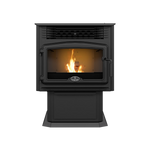
A freestanding top-feed pellet stove with electronic ignition, 60 lb hopper, thermostatic control, and 17 1/4" × 9 1/2" ceramic glass. EPA / CSA B415.1-10 tested at 70.3% HHV efficiency and 0.96 g/hr emissions — among the cleanest-burning pellet stoves in its category. 500–2,000 sq ft heating area, 6,648–28,540 BTU/hr tested output, up to 51-hour maximum burn on a full hopper at low setting. Approved for both alcove and mobile-home installation (US and Canada). Ships as a single configuration; no buyer-configurable choices at order.
Who this is for
Right buyer
Owners of moderately to well-insulated homes between roughly 800 and 1,800 sq ft who want a freestanding wood-pellet heating appliance with the convenience of automatic ignition, thermostatic control, and 24+ hour unattended burn cycles — not the hands-on operation of a wood stove.
Buyers who want a meaningfully cleaner-burning pellet appliance than the median in the category. The Osburn 2500's 0.96 g/hr particulate emissions is well below the EPA pellet stove limit of 2.0 g/hr and roughly 1/3 the emissions of the larger Osburn 3000 (2.9 g/hr). For buyers in EPA non-attainment counties or HOA-restricted neighborhoods, this matters.
Owners of small homes, manufactured homes, mobile homes, or alcove installations. The 2500 is approved for both alcove and mobile-home installations in the US and Canada — uncommon dual approval that opens installation locations many other appliances can't serve. Tight clearances (3" back wall, 6" side wall) reflect the cool exhaust and contained combustion of pellet appliances generally and this model's compact thermal envelope specifically.
Buyers replacing an older pellet stove, or first-time pellet stove buyers stepping over from a wood stove or oil/propane appliance who want a simpler operating experience. Thermostatic control plus the optional digital wall thermostat (AC05558) lets the stove cycle on heat demand like a furnace — load the hopper, set the thermostat, walk away.
Buyers who can accept that a pellet stove requires household electricity to operate. Pellet stoves use mechanical draft (combustion blower, exhaust blower, auger motor) and have no manual operating mode — when the power is out, the stove is off. Buyers in regions with frequent multi-day outages should plan for a battery backup or generator, or choose a wood-burning appliance.
Wrong buyer
Not for buyers who want a wood-burning experience. Pellet stoves burn manufactured wood pellets, not cordwood. The visual is a contained flame inside a burn pot, not a stacked-log fire. If the aesthetic of wood is a primary requirement, look at a freestanding wood stove (Osburn 1700, 2000, or Matrix 2700) instead.
Not for buyers heating more than ~1,800 sq ft as primary winter heat. The 2,000 sq ft figure on the manufacturer's range is aspirational; for primary heat in larger spaces, step up to the Osburn 3000 (2,200 sq ft, larger heat output) or look at higher-capacity pellet stoves with bottom-feed combustion for sustained high-output operation.
Not for buyers in regions with frequent or extended power outages who don't have backup power. Without electricity, the auger, igniter, combustion blower, and exhaust blower do not operate — the stove will not run. Wood appliances are the right choice for off-grid or unreliable-grid scenarios.
Not for buyers expecting a silent appliance. The Osburn 2500 operates at 47–60 dBa at 6 feet per manufacturer spec. Multiple owner reviews flag the blower as audible. Compared to a furnace, this is normal pellet-stove operating sound; compared to a silent wood stove, it is a real difference. Sit near a running pellet stove at a dealer before purchase if quiet operation is a priority.
Not for buyers who don't have a reliable supplier of premium-grade wood pellets. Pellet quality directly drives stove performance and maintenance cadence — high-ash pellets clog the burn pot, high-moisture pellets cause ignition failures. Verify local pellet supply (and storage space for off-season buying) before committing to a pellet appliance.
At a glance
Where it can go
The Osburn 2500 is designed for installation in a permitted residential space — a living room, family room, basement, finished workshop, manufactured home, or mobile home with adequate electrical service and a vent path to the exterior. Approved for both alcove and mobile-home installations in the US and Canada per the manufacturer listing — uncommon dual approval that opens installation locations many other solid-fuel appliances can't serve.
Clearances to combustibles
Tight clearances compared to wood-burning freestanding stoves — a function of cool pellet exhaust and contained combustion. The certification label on the unit is the binding clearance for any installation and always overrides clearance figures published in any other media. Confirm the binding clearance figures with your installer before purchase.
Floor protection / hearth pad
A non-combustible floor protector is required under and around the appliance unless the existing floor is already non-combustible (concrete, slate, etc.). In Canada, the floor protector must extend at least 18 inches in front of the door opening and at least 8 inches at the back and on each side of the appliance. In the US, the floor protector must extend at least 6 inches in front of the door opening and extend at least 6 inches beyond each side of the door opening. Minimum thickness 0.015 inches (0.38 mm). The manufacturer offers pre-sized options including the Black Steel Hearth Pad in 41 1/4" × 44" (AC02709B), 46 3/4" × 54" (AC02788), and 54" corner (AC02789); tempered glass options (AC02704, AC02757); and the modular floor protection system 54" × 46 3/4" (AC02711) for buyers wanting a coordinated finished look.
Vent system
The Osburn 2500 vents through a 3-inch Type L pellet vent — not a wood-burning chimney. Pellet vent is double-wall stainless steel inside with galvanized outer wall, certified to ULC-S609M / ORD-C441 in Canada or UL 641 in the US. Vent path can be horizontal (through-the-wall termination), vertical (through-the-roof termination), or run through an existing masonry chimney with a stainless steel liner inside it. Do not install a flue damper in a pellet vent system. Do not connect a pellet vent to any other appliance's venting system.
For installations at high elevation or with long vertical runs, a 4-inch vent may be required — verify with installer and manufacturer spec. The 2" × 25' anti-static flex hose (SBI AC01465) is sold separately for specific routing scenarios.
Outside air intake
A fresh-air intake is not mandatory in all installations but is required for mobile-home installations and strongly recommended for tight new-construction homes with mechanical ventilation, for homes with powerful range hoods or other mechanical exhaust appliances, and where local code requires it. The 3" × 10' insulated flex pipe (SBI AC02092) and 3" × 5' fresh air intake kit (SBI AC01240) are sold separately for buyers configuring outside-air installations.
Electrical and power supply
The Osburn 2500 requires a continuous 120 VAC household supply. Continuous operation draws 1.3–2.5 A (140 W); ignition cycle draws 2.6 A (312 W) for the first few minutes of cold start. Use a properly grounded 3-prong outlet on a dedicated circuit if possible. The manufacturer does NOT recommend GFCI receptacles — GFCI trips can shut down the appliance unnecessarily and disrupt operation. Plan for an uninterruptible power supply (UPS) or battery backup if the appliance is the primary heat source in an outage-prone region.
Code compliance
Code compliance for any specific installation is determined by the local Authority Having Jurisdiction. Manufacturer listings cover what the stove is approved for; the AHJ approves what is permitted at your address. A WETT (Canada), NFI, or CSIA (USA) certified installer is strongly recommended and frequently required by code, permit, or insurance.
California Proposition 65
This product can expose you to chemicals including carbon monoxide, which is known to the State of California to cause cancer, birth defects or other reproductive harm. For more information go to www.P65warnings.ca.gov.
What's in the box, what you'll add
Ships with the stove
- Osburn 2500 freestanding pellet stove with welded steel body, single cast-iron-framed ceramic glass door, and stainless-steel heat exchangers
- 60 lb integrated hopper with top-feed auger system and electronic igniter
- Combustion blower, convection blower, and integrated electronic control panel with six heat settings and adjustable convection speed
- Stainless-steel baffle and adjustable threaded legs for leveling on uneven floors
- Owner's installation and operation manual and product documentation
Sold separately
- Code-compliant 3-inch Type L pellet vent system — pellet vent components from a listed manufacturer; required vent path is sold separately
- Floor protector or hearth pad sized to manual specifications — manufacturer options include Black Steel Hearth Pad 41 1/4" × 44" (SBI AC02709B), 46 3/4" × 54" (SBI AC02788), 54" corner (SBI AC02789); Tempered Glass Hearth Pad 44" × 36" (SBI AC02704); Tinted Tempered Glass Hearth Pad 44" × 36" (SBI AC02757); Modular Floor Protection System 54" × 46 3/4" (SBI AC02711)
- Optional Digital Wall Thermostat (SBI AC05558) — remote-mounted thermostatic control; the stove cycles on/off based on room temperature demand
- Optional Hopper Extension (SBI AC01393) — increases hopper capacity beyond the standard 60 lb for longer unattended burn cycles
- Optional Storage Tank with Pneumatic Self-Feeding Pellet System (SBI AC01460) — bulk pellet storage with automatic feed to the stove; for buyers who want furnace-like multi-day unattended operation
- Optional Storage Tank Extension (SBI AC01462) — adds capacity to the AC01460 storage tank
- Optional Stand Alone Auxiliary Discharge Tank (SBI AC01463) and Leg Assembly (SBI AC01464) — auxiliary pellet handling for bulk storage installations
- Optional 2" × 25' Anti-Static Flex Hose (SBI AC01465) — for specific vent routing scenarios
- Optional 3" × 10' Insulated Flex Pipe for fresh air intake (SBI AC02092) and 3" × 5' Fresh Air Intake Kit (SBI AC01240) — required for mobile-home installations, recommended for tight homes
- Optional 3" Pellet Stove Cleaning Kit (SBI AC02712) — sweep brushes and rod for vent maintenance
- 3" Round Pellet Stove Brush (SBI AC04505), 4" Round Pellet Stove Brush (SBI AC04506), 5' Pellet Stove Flexible Rod (SBI AC04510) — individual cleaning components
- Pellet Appliance Glass Cleaner (SBI AC07827) and Dry Cleaning Pad (SBI AC07824) — glass and component cleaning
- Optional Certified Modular Heat Shield System 53" × 58 1/2" (SBI AC02762) and Heat Shield Extension (SBI AC02713) — for installations requiring additional wall shielding
- Installation by an authorized qualified technician (WETT, NFI, or CSIA certified) — required for warranty coverage and often required by code, permit, or insurance
- Battery backup or UPS — strongly recommended in regions with frequent power outages if the stove is the primary heat source
How it actually performs
The 39,260 BTU/hr maximum is a heat input rating based on the peak burn rate of 4.7 lb/hr and a dry pellet energy value of 8,600 BTU/lb. Heat output to the room is lower than heat input — the realistic operating band is 6,648–28,540 BTU/hr per the CSA B415.1-10 stack-loss method.
A realistic operating day, primary-heat use, cold climate: thermostat set to desired room temperature, stove cycles between heat levels 1–6 based on demand. In a well-insulated 1,500 sq ft home in moderate winter, the stove typically runs at heat levels 2–3 during the day and 3–4 at night, with the convection blower at low to medium speed. A full 60-lb hopper supports 18–24 hours of continuous heating at this load.
The 0.96 g/hr particulate emissions figure is the standout spec on this appliance. Less than half the EPA pellet stove limit of 2.0 g/hr. Roughly one-third the emissions of the larger Osburn 3000 (2.9 g/hr). For buyers in EPA non-attainment counties, in HOA jurisdictions with emissions restrictions, or simply paying attention to clean-burn metrics independent of regulatory minimums, this is a meaningful number.
Pellet stoves throw heat differently than wood stoves. The convection blower pushes warm air horizontally into the room — heat distribution is more directional and less radiant than a freestanding wood stove. Buyers replacing a wood stove with a pellet stove sometimes report the "feel" of the heat as different, even at comparable BTU output. The optional digital wall thermostat (AC05558) lets the appliance run like a furnace — set and forget.
The 51-hour maximum burn time is achieved at the lowest setting (1.2 lb/hr) on a full hopper. Useful continuous operation at low setting. At realistic heat-demand levels for primary winter heat (3.0–4.0 lb/hr), expect reload cadence of 15–20 hours per full hopper.
The 70.3% HHV average efficiency is higher than most wood-burning freestanding stoves at comparable output — a structural advantage of pellet combustion's controlled fuel-air ratio. The 78.4% LHV optimum at the specific test burn rate is competitive with mid-tier catalytic wood appliances. HHV is the federal standard.
The CO emissions figure of 7.6 g/hr is dramatically lower than wood-burning freestanding stoves at comparable output (typically 60–160 g/hr) — again, a function of controlled pellet combustion. For buyers concerned about indoor and outdoor air quality, pellet appliances generally outperform wood appliances on this metric, and the 2500 is at the low end of the pellet category.
The glass air-wash system keeps the ceramic viewing window largely clear during normal operation. Buyers should expect to wipe the glass weekly with the manufacturer's pellet appliance glass cleaner (AC07827) or a dry cleaning pad (AC07824); pellet combustion produces less creosote staining than wood combustion but still leaves a fine ash film on the glass over time.
Multiple owner reviews flag the blower fan as noisy, especially at higher settings. The published 47–60 dBa range at 6 feet is realistic — at low settings the appliance is genuinely quiet, but at high settings the convection blower is clearly audible. Sit near a running unit at a dealer before purchase if quiet operation is a priority.
Trade-offs to know
Single SKU, no buyer choices at order. The Osburn 2500 ships as one configuration. No faceplate options, no door overlay choices, no louver styles. What you see in the manufacturer image is the appliance you receive. Customization is limited to where you place it and what hearth pad and venting you specify.
Top-feed combustion is pellet-quality sensitive. Top-feed pellet stoves drop pellets into the burn pot from above; the residue accumulates and can form a crust if the pellets have ash content above 1%. Premium-grade pellets run reliably; lower-grade pellets require more frequent burn-pot cleaning and can cause shutdowns. For higher-ash pellets, consider the bottom-feed Osburn 3000 (which pushes residue out of the burn area as fuel consumes).
Pellet stoves need electricity to operate. The auger motor, combustion blower, exhaust blower, and electronic igniter all require 120 V AC. No power means no heat — there is no manual operating mode. Buyers in regions with frequent multi-day outages should plan for battery backup, UPS, or a generator, or choose a wood-burning appliance for off-grid resilience.
Blower noise is real. The 47–60 dBa published range at 6 feet is honest. At low settings the appliance is genuinely quiet. At high settings the convection blower is clearly audible — comparable to a quiet bathroom exhaust fan. Multiple owner reviews flag this. If you're sensitive to mechanical sound, sit near a running unit at a dealer.
Pellet supply and storage are buyer responsibilities. A pellet appliance requires a reliable supplier of premium-grade pellets, ideally bought by the ton and stored dry. Off-season buying (spring/summer) is cheaper than peak-season buying. A ton of pellets occupies approximately 50 cubic feet and weighs 2,000 lb — plan for garage, basement, or shed storage space that stays dry. Pellets stored in damp conditions absorb moisture and burn poorly.
Not a wood-burning aesthetic. The flame is contained inside a burn pot — visible through the wide glass, but constrained in size and shape compared to the stacked-log fire of a wood appliance. Some buyers love this aesthetic; some buyers want the wood fire experience and feel let down by the pellet flame. Visit a dealer with a running stove before purchase if the aesthetic matters.
Ash needs regular handling. Pellet combustion produces fine ash that accumulates in the burn pot and ash pan. Daily inspection of the burn pot during continuous use; weekly cleaning of the ash pan, glass, and combustion blower fins; monthly or quarterly cleaning of the heat exchanger and vent system depending on usage. Less ash than a wood stove, but not maintenance-free.
Annual professional service is the right cadence. Pellet stoves have moving parts (auger motor, blowers, igniter) that benefit from annual technician inspection and service. Plan for an annual service call as part of operating budget.
Replacement parts and consumables. Plan for igniter replacement every 3–5 seasons depending on usage (the igniter is a heating element that cycles every cold start). Blower replacement, gasket replacement, and burn pot replacement are normal maintenance items over the life of the appliance. The SBI parts network is well-stocked; replacement components are openly available through dealers and parts vendors.
"Heat input" not "heat output" on the headline BTU rating. The 39,260 BTU/hr peak figure is the fuel energy input rate, not the heat delivered to the room. Heat output is 6,648–28,540 BTU/hr per the CSA stack-loss test. Pellet stove specs sometimes confuse buyers comparing to wood stove "max heat output" numbers — make the comparison on tested output, not headline rating.
Operating reality
First fires. The first one or two operating cycles release paint VOCs as the thermosetting powder paint cures. Ventilate the room well. Avoid prolonged exposure. The smell disappears after the first several hot operating cycles.
Starting the stove. Press AUGER first if the stove is out of pellets or starting for the season — this fills the auger with pellets so the burn pot receives fuel immediately on ignition. Then press the start button on the control panel (or trigger via the optional digital wall thermostat AC05558). The stove ignites automatically — no kindling, no fire starter, no match. Cold start to operating temperature in approximately 8–12 minutes.
Hopper loading. The 60-lb hopper accepts pellets directly from the bag through the top opening. Pour the bag slowly to avoid spilling fines (the fine dust at the bottom of pellet bags). Keep fines out of the hopper if possible — they can affect feed consistency. Some operators sift pellets through a kitchen colander before loading to remove fines.
Daily inspection. Check the burn pot for ash buildup; if a crust is forming, scrape it loose with the supplied tool. Check the glass for ash film; wipe if needed. Check the hopper level and refill as needed.
Weekly maintenance. Empty the ash pan. Clean the glass with pellet appliance glass cleaner (AC07827) or a damp cloth — never abrasive scrubbers, never strong chemical cleaners. Brush out the burn pot completely. Check the combustion blower fins for ash buildup.
Monthly maintenance. During heavy heating season, brush out the heat exchanger tubes using the threaded heat exchanger rod (a service tool that comes with the appliance). This is important — clogged heat exchanger tubes reduce efficiency and increase fuel consumption.
Annual service. Have an authorized technician inspect and service the appliance once per year before heating season. The annual service includes vent system inspection, gasket inspection, blower service, electronic control board check, and igniter test. Annual service is a significant predictor of appliance longevity.
Vent cleaning. The vent system should be checked at least twice a year for soot and creosote buildup per the manual. Pellet vent runs cooler than wood-burning chimney, so creosote formation is much lower, but the vent still accumulates fine ash and fly ash that needs to be cleared. The 3" pellet stove cleaning kit (SBI AC02712) is the manufacturer-supplied tool kit for this.
Pellet storage. Store pellets in their original sealed bags in a dry location. Pellets that absorb moisture swell, lose their binders, and burn poorly. A garage or shed is fine if dry; a damp basement is not. Plan for storage of at least one heating season's pellets (typically 3–5 tons for a primary-heat installation).
Power outage handling. When AC power is lost, the stove shuts down. The combustion blower stops, the auger stops, the igniter cools. If the outage is brief (under an hour), the stove will restart automatically when power returns and will resume operation. If the outage extends, the stove will need to cool fully before restart; clear any unburned pellets from the burn pot before relighting. For primary-heat installations in outage-prone regions, a battery backup or UPS is strongly recommended.
Fuel quality. Burn only premium-grade wood pellets with ash content 1% or lower. Burning corn, other biomass, non-certified pellets, or wet pellets is prohibited by the manufacturer, voids the warranty, and damages the appliance. Look for PFI Premium, ENplus A1, or CANplus Premium certification on the bag.
Blower management. Adjust the convection blower speed (AUX button) to balance heat distribution against noise. Lower convection speed pushes heat slowly out of the front of the stove and runs quieter; higher convection speed throws heat farther into the room and runs louder. Find the right balance for your space and noise tolerance.
What never to burn. Per the manual: no corn, no non-pellet biomass, no cardboard, no paper, no wood scraps, no painted wood, no treated wood, no garbage. Pellet appliances are certified for one fuel only — premium-grade wood pellets. Burning anything else damages the appliance and voids the warranty.
Warranty and service
The Osburn limited lifetime warranty applies to the original retail purchaser only and is non-transferable. The warranty applies to normal residential use only. Proof of purchase (dated bill of sale), model name, and serial number are required for any warranty claim. Online registration is recommended at osburn-mfg.com but not required if a dated invoice is retained.
Coverage by component
A one-time replacement limit applies to all parts with lifetime coverage. Warranty is void if the unit is used to burn anything other than premium-grade wood pellets, or if it is not operated according to the owner's manual. Damage caused by misuse, improper installation, lack of maintenance, fuel quality issues, power surges, downdrafts, or venting problems is not covered. Improper installation by anyone other than an authorized qualified technician voids the warranty.
Warranty claims are made through your Osburn dealer and remain subject to SBI/Osburn inspection, approval, and the current written warranty. Kaminos is the retailer for this stove and supports buyers through purchase; final warranty approval rests with SBI as the manufacturer. SBI's parts network is well-stocked — replacement augers, blowers, igniters, gaskets, glass, control boards, and venting components are openly available at fair prices through multiple parts vendors.
Osburn may require photos or returned parts to support a claim; repair work covered by warranty requires prior manufacturer approval.
Coverage details can change by component and warranty revision; the current Osburn warranty controls.
Compare with
A clean-burning pellet stove with thermostatic control, alcove and mobile-home approvals, and tested emissions at 0.96 g/hr — among the lowest in the SBI pellet lineup. Load the hopper, set the thermostat, walk away — and check the burn pot daily. For buyers who want pellet convenience and the cleanest combustion they can buy without crossing into premium-brand pricing.
If you have any questions about this product, please let us know by filling out the form below, and we will contact you as soon as possible.
- Choosing a selection results in a full page refresh.