


Osburn 2000-I Wood Insert
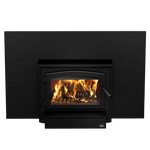
At a glance
- Type: Wood insert, EPA 2020 certified
- Heats: 500–2,100 sq ft
- Heat output: 75,000 BTU/hr
- Log length: 16 in east-west
- Efficiency: 72% HHV / 77% LHV
- Burn time: Up to 8 hours
- Chimney: 6 in (insert liner)
Description
The Osburn 2000-I Wood Insert is an EPA 2020 certified wood insert for 500 to 2,100 sq ft. It burns up to 8 hours on a load and takes a 6-inch (insert liner) chimney.
Who it's for
Right buyer. Owners of a working masonry fireplace who want to convert an inefficient open hearth into a serious primary heat source — up to 2,100 sq ft of zone heating capability with a 2.4 ft³ firebox, 20-inch log capacity, and an 8-hour maximum burn cycle.
Buyers with a medium-depth masonry opening that won't take the deeper Inspire 2000-I.
How it performs
The 75,000 BTU/hr maximum is a peak rating, transient, achieved on dry cordwood at high loading density and short reload intervals. It is real, but it is a peak rating, not the average output across a full burn cycle of normal operation.
Good to know
- Less powerful blower than newer Osburn inserts.
- Shallow-depth advantage.
- Substantial masonry opening required overall. The 23 3/8" H × 28 7/8" W footprint is still a real requirement — narrower fireplaces won't accept it.
Specifications
Dimensions
Minimum fireplace opening
Measure the inside of the firebox: width, height and depth. The insert needs at least this much, and the faceplate covers the rest of the old opening.
| Width | Height | Depth |
|---|---|---|
| 28‑7/8" | 23‑3/8" | 15‑3/4" |
Dimensions from the specification sheet
| Measurement | Value |
|---|---|
| Overall height | 23‑1/8" |
| Overall width | 28‑3/8" |
| Overall depth | 26‑1/2" |
| Shipping weight | 421 lb |
| Door opening | 17‑1/2 W |
| Firebox, W x H x D | 21 W x 11‑7/8 H x 16‑3/4 D |
Dimensions
| Measurement | Value |
|---|---|
| Firebox volume | 2.4 ft³ overall / 1.95 ft³ EPA |
| Glass | 17 1/8" x 10 1/4", ceramic |
| Door opening | 17 1/2" W x 9" H |
| Overall dimensions | 28 3/8" W x 26 3/8" D x 23 1/8" H |
| Shipping weight | 432 lb |
Where it can go
The 2000-I is approved only for installation inside an existing code-compliant masonry fireplace with a continuous stainless-steel chimney liner. It is not approved for installation in factory-built (prefab) metal fireplaces, in mobile or manufactured homes, in alcoves, or as a freestanding unit. The masonry fireplace and chimney must be inspected before installation for cracks, loose mortar, creosote, blockage, or other signs of deterioration.
Clearances to combustibles
Floor protection
Floor protection requirements depend on whether the existing masonry hearth is raised above the surrounding combustible floor and whether it extends sufficiently in front of the appliance. The manual requires a non-combustible floor protector extending at least 16 inches in front of the unit in the USA or 18 inches in Canada, measured from the door opening. If the masonry hearth is level with or only slightly raised above the surrounding combustible floor, an R-value floor protector may be required per the manual's floor-protection worksheet.
The manual includes a thermal-resistance lookup table for common floor protection materials (brick, cement board, ceramic tile, marble) to calculate the required R-value combination. Tile alone is not sufficient — the manual requires a continuous non-combustible sheet beneath any tile installation. Final hearth protection must be calculated from the manual's floor-protection worksheet and approved by the installer/AHJ.
Clearances
United States figures, in inches. The rating plate on the appliance overrides any published number; the installer confirms on site.
| Clearance | Minimum |
|---|---|
| Ceiling, from the floor the stove sits on | 84" |
| Combustible side mantel | 9" |
| Combustible top mantel | 27" |
| Combustible side wall | 16" |
Notes from the manual
The certification label on the back of the insert always overrides clearance figures published elsewhere. An optional heat shield (SBI AC01317, 7 3/16" × 26") is available for surround/shelf applications where additional protection is needed.
Documents
- Osburn 2000 wood insert install & owner's manual (PDF - 5.2 MB)
- Osburn 2000-I Dimensions (PDF - 1.0 MB)
- Maximum recommended heating area by climate zone (PDF)
- Osburn wood products brochure, USA edition, with dimension drawings (PDF)
- Osburn limited lifetime warranty
- EPA test reports
- Replacement parts
Details
| Combustion technology | Non-catalytic |
|---|---|
| Installation type | Masonry insert |
| Firebox volume | 2.4 ft³ overall / 1.95 ft³ EPA |
| Maximum heat output | 75,000 BTU/hr |
| Tested output range | 14,200–44,500 BTU/hr |
| Heating range | 500–2,100 sq ft |
| Average efficiency | 72% HHV / 77% LHV |
| Particulate emissions | 2.3 g/hr |
| Maximum burn time | Up to 8 hours |
| Recommended log length | 16 in east-west |
| Maximum log length | 20 in east-west |
| Construction | Carbon steel, cast-iron door |
| Faceplate | Regular or Large |
| Glass | 17 1/8" x 10 1/4", ceramic |
| Blower | Included, 144 CFM |
| Baffle | C-Cast |
| Flue connection | 6 in (insert liner) |
| Combustion chamber | 21" W x 16 3/4" D x 11 7/8" H |
| Door opening | 17 1/2" W x 9" H |
| Overall dimensions | 28 3/8" W x 26 3/8" D x 23 1/8" H |
| Minimum masonry opening | 23 3/8" H x 28 7/8" W x 15 3/4" D |
| Shipping weight | 432 lb |
| Mobile home approved | No |
| Country of origin | Made in Canada |
| Model | OB02016 |
| Manufacturer | Osburn, by Stove Builder International (SBI), Quebec, Canada |
| Certification | UL 1482, UL 737, ULC S628; EPA 2020 |
| Warranty | Limited lifetime |
| Specification source | SBI specification table as published by Osburn dealers (ruralenergy.com, blazingembers.com), 2026 |
Warranty
A one-time replacement limit applies to all parts with lifetime coverage. Warranty is void if the unit is used to burn anything other than seasoned cordwood, or if it is not operated according to the owner's manual. Damage caused by misuse, improper installation, lack of maintenance, overfiring, downdrafts, venting problems, or under-estimated heating area is not covered. Improper installation by anyone other than an authorized qualified technician voids the warranty.
Warranty claims are made through your Osburn dealer and remain subject to SBI/Osburn inspection, approval, and the current written warranty. Kaminos is the retailer for this insert and supports buyers through purchase; final warranty approval rests with SBI as the manufacturer. SBI's parts network is well-stocked — replacement bricks, baffle, secondary tubes, glass, gaskets, and blower are openly available at fair prices through multiple parts vendors.
Osburn may require photos or returned parts to support a claim; repair work covered by warranty requires prior manufacturer approval.
Coverage details can change by component and warranty revision; the current Osburn warranty controls.
Heat
From the specification sheet
| Spec | Value |
|---|---|
| Heating area | 500 to 2,100 sq ft |
| Maximum heat output | 75,000 BTU/h |
| Burn time | 6 h |
| Firebox volume | 2.4 cu ft |
| Log length | 20 in |
| Blower | included |
| Spec | Value | What it means |
|---|---|---|
| Combustion technology | Non-catalytic | Secondary-air tubes reignite smoke gases. No catalyst to replace; one air-control lever; simpler operation than a cat insert but shorter low-and-slow burn times. |
| Maximum heat output | 75,000 BTU/hr | Peak output on dry cordwood, transient. Sustained output across a burn cycle is substantially lower. |
| Heating range | 500–2,100 sq ft | Manufacturer's stated range. Real-world comfort sizing for primary heat is roughly 1,400–1,900 sq ft in moderate climates and lower in cold climates or older homes — depends on insulation, layout, climate, ceiling height, fuel quality, and installation. |
| Average efficiency | 72% HHV / 77% LHV | 79% optimum overall efficiency at low burn rate; 76% optimum heat transfer efficiency. HHV is the federal standard. Government incentives may apply by jurisdiction and installation date. |
| Particulate emissions | 2.3 g/hr | Per manufacturer's published spec table. EPA 2020 limits are 2.0 g/hr crib-wood or 2.5 g/hr cordwood. The 2000-I is compliant with the federal cordwood standard. |
| Maximum burn time | Up to 8 hours | Manufacturer maximum at the lowest air setting. Useful heat through a burn cycle is realistically 6–7 hours. |
| Recommended log length | 16 in east-west | Per manual. Most firewood suppliers cut to this length. |
| Maximum log length | 20 in east-west | 4-inch margin over the recommended length — meaningful for buyers with access to longer-cut firewood. Logs load across the width of the firebox, sides visible from the door. |
| Combustion chamber | 21" W x 16 3/4" D x 11 7/8" H | Inside firebox dimensions per manufacturer spec. Designed for east-west loading across the width of the firebox. |
Choices and prices
Options
The unit price is Osburn's 2026 list price for the wood insert alone. Options sold on this page add to it; those marked on request we add to your order by hand.
Door overlay
| Door overlay | Part | Price |
|---|---|---|
| BLACK DOOR OVERLAY | OA10237 | $110 |
| BRUSHED NICKEL DOOR OVERLAY | OA10238 | $330 |
Faceplate and trim
| Faceplate and trim | Part | Price |
|---|---|---|
| REGULAR FACEPLATE (29" X 44") | AC03410 | $170 |
| LARGE FACEPLATE (32" X 50") | AC03411 | $220 |
| BLACK FACEPLATE TRIMS (29" X 44") | OA10122 | $130 |
| BRUSHED NICKEL FACEPLATE TRIMS (29" X 44") | OA10123 | $130 |
| BLACK LARGE FACEPLATE TRIMS (32" X 50") | OA10128 | $130 |
| BRUSHED NICKEL LARGE FACEPLATE TRIMS (32" X 50") | OA10129 | $130 |
| 7 3/16" X 26" HEAT SHIELD FOR SURROUND/SHELF (on request) | AC01317 | $120 |
| 32'' X 50'' CUTTABLE FACEPLATE (18 GA) (on request) | AC01357 | $220 |
Fresh air
| Fresh air | Part | Price |
|---|---|---|
| 5"Ø FRESH AIR INTAKE KIT (on request) | AC01298 | $100 |
| 5''Ø FRESH AIR INTAKE REGISTER WITH AIRTIGHT DAMPER (on request) | AC01349 | $285 |
| 5"Ø X 4' INSULATED FLEX PIPE FOR FRESH AIR INTAKE (on request) | AC02090 | $50 |
Other options
| Other options | Part | Price |
|---|---|---|
| OFFSET LINER ADAPTER (on request) | AC01214 | $295 |
| RIGID FIRESCREEN (on request) | AC01315 | $200 |
| LINER HOOK UP SYSTEM (on request) | AC02006 | $120 |
| TEMPERED GLASS HEARTH PAD 10 mm - 18" X 50" (on request) | AC02760 | $399 |
What arrives
- Osburn 2000-I wood insert (OB02016) with welded carbon-steel firebox and cast-iron arched glazed door
- Configured at order with required faceplate selection (Regular 29" × 44" or Large 32" × 50") — see "Where it can go" for the options
- 144 CFM premium-quality variable-speed blower with rheostat speed control and thermodisc auto-on
- C-Cast baffle and stainless-steel secondary-air tube assembly
- Moulded refractory bricks lining
- Adjustable threaded legs
- Removable air-control handle
- Liner fixation brackets and hardware
- Owner's manual and product documentation
Sold separately
- 6-inch continuous stainless-steel chimney liner kit (UL 1777, CAN/ULC-S635, or CAN/ULC-S640) — required for installation, sized to the chimney height
- Hearth extension or floor protector sized per manual specifications, extending at least 16 inches in front of the unit in the USA, 18 inches in Canada
- Sheet-metal block-off plate, high-temp silicone, and mineral wool insulation — effectively required in practice for the insert to deliver rated performance
- Optional faceplate trim package in Black or Brushed Nickel — configured at order to match the chosen faceplate size
- Optional steel door overlay in Black or Brushed Nickel — configured at order
- Optional 32" × 50" cuttable faceplate, 18 GA (SBI AC01357) — for masonry openings larger than the Large faceplate covers
- Optional 7 3/16" × 26" heat shield for surround/shelf (SBI AC01317) — for installations requiring additional surround protection
- Optional 5-inch fresh-air intake kit (SBI AC01298) — for code jurisdictions requiring outside combustion air or for tight new-construction homes
- Optional 5-inch × 4' insulated flex pipe for fresh-air intake (SBI AC02090) — HVAC type, ULC S110 or UL 181 class 0 or class 1
- Optional 5-inch fresh-air intake register with airtight damper (SBI AC01349) — do not close while in use
- Optional rigid firescreen (SBI AC01315) — for occasional attended fire viewing only where permitted by local code and only when used exactly as instructed in the fire screen manual; never leave the insert unattended when used with a fire screen
- Optional liner hook-up system (SBI AC02006) — simplifies liner-to-flue-collar connection
- Optional offset liner adapter (SBI AC01214) — for installations where the chimney throat geometry requires offset connection
- Optional tempered glass hearth pad 10mm 18" × 50" (SBI AC02760)
Installation
Chimney requirements from the specification sheet
| Requirement | Value |
|---|---|
| Flue | 6 in liner |
| Chimney type | Liner |
| Flue center | 13‑1/2 in from the side, 6‑7/8 in from the back |
The 2000-I requires a continuous 6-inch stainless-steel chimney liner extending from the insert flue collar to the top of the chimney. The liner must conform to ULC S635, CAN/ULC-S640 (Canada) or UL 1777 (USA) and be rated for solid fuel. The minimum liner height is 12 feet, subject to installer verification, certification label, draft conditions, and local code. The chimney must extend at least 3 feet above the highest point of contact with the roof and at least 2 feet above any roof line or obstacle within 10 feet horizontally.
The 2000-I performs best with a 6-inch stainless-steel chimney liner. In the USA, use a 6-inch liner listed to UL 1777. In Canada only, connection to a chimney liner of at least 5 inches may be permitted if it properly vents combustion gases, the total masonry chimney height is greater than 20 feet, and the application is verified and authorized by a qualified installer. The insert is not approved for a positive flue connection to clay tile — a continuous stainless liner is required.
If the existing fireplace's throat damper is to remain, it must be locked open to clear the liner; otherwise the damper plate must be removed. A sheet-metal block-off plate sealed at the damper level (or, in Canada per CSA B365, mineral wool packing around the liner) is recommended at the throat to reduce cold-air backdraft and to allow the insert to deliver rated performance — without it, jacket-recovered heat is lost into the smoke chamber. An insulated liner (or pre-insulated liner with a wrap) improves draft and reduces creosote, and is required by code in some jurisdictions for clearance reasons.
Outside air
An optional 5-inch fresh-air intake kit is available for code jurisdictions requiring outside combustion air or for tight new-construction homes with mechanical ventilation. In conventional homes the manual identifies room air as the safest and most reliable supply for combustion; almost all houses have enough natural leakage to provide what the insert needs. A smoke detector and carbon monoxide detector are required in the room where the insert is installed.
Codes and approvals
Code compliance for any specific installation is determined by the local Authority Having Jurisdiction. Manufacturer listings cover what the insert is approved for; the AHJ approves what is permitted at your address. A WETT (Canada), NFI, or CSIA (USA) certified installer is strongly recommended and frequently required by code, permit, or insurance. In Canada the CSA B365 standard applies; in the USA, ANSI NFPA 211 applies. Confirm local requirements before purchasing — particularly in EPA non-attainment counties and in HOA jurisdictions where new wood-burning installs may be restricted.
California Proposition 65
This product can expose you to chemicals including carbon monoxide, which is known to the State of California to cause cancer, birth defects or other reproductive harm. For more information go to www.P65warnings.ca.gov.
Planning the install
- Check with your building department and insurer: wood appliances need a permit in most places and an inspection after installation.
- The chimney is the other half of the system. It is sold separately and quoted from your installer's plan.
- Clearances and floor protection come from the manual and depend on the pipe and shields you choose. Send us your plan and we will check it.
- Burn seasoned wood below 20 percent moisture. Wet wood is the cause of most complaints about any wood stove.
- Special-order goods ship by freight.
Questions
How does it compare with the other Osburn models?
- Osburn Inspire 2000-I Wood Insert Same firebox class — 2.4 ft³, same 75,000 BTU/hr maximum, same 14,200–44,500 BTU/hr tested range, same 500–2,100 sq ft heating range, same 72% HHV efficiency, same 2.3 g/hr emissions, same 8-hour burn time, same 20-inch log capacity. Two key differences: blower (Inspire 176 CFM vs 2000-I 144 CFM) and aesthetic (Inspire modern flush picture-window vs 2000-I traditional cast-iron with configurable trims). The 2000-I requires meaningfully less masonry depth (15 3/4" vs Inspire's 20 3/4"). Choose the 2000-I for shallower masonry openings and traditional configurable aesthetic; choose the Inspire for deeper openings, more powerful blower, modern picture-window aesthetic, and the optional NightFlame glass.
- Osburn 1700-I Wood Insert Step-down sibling in the Osburn insert line. Smaller 1.86 ft³ firebox, 65,000 BTU/hr maximum, 500–1,800 sq ft heating range, 18-inch log capacity, 7-hour maximum burn, same 144 CFM blower, 68% HHV efficiency, 1.7 g/hr emissions. Smaller masonry opening required (21 1/2" × 27 1/2" × 12 7/8") — fits even shallower openings the 2000-I won't. Choose the 1700-I for smallest masonry openings and smaller spaces; choose the 2000-I for larger firebox, longer log capacity, and slightly higher published efficiency.
- Osburn 3500-I Wood Insert Step-up sibling in the Osburn insert line. Larger 3.5 ft³ firebox, 110,000 BTU/hr maximum, 1,000–2,700 sq ft heating range, 22-inch log capacity, 10-hour maximum burn, 71% HHV efficiency, 1.6 g/hr emissions, same 144 CFM blower. Loads over both width and depth (the deepest firebox in the Osburn insert line at 20 1/8"). Larger minimum masonry width (31") but similar depth requirement. Choose the 3500-I for primary heat above 2,000 sq ft, longer log capacity, north-south loading flexibility, and longer burn cycles; choose the 2000-I for shallower masonry depth and lower BTU output appropriate for 1,500–2,000 sq ft spaces.
- Pacific Energy Super LE Insert Cross-brand competitor in the same size class. Comparable firebox volume and heating capacity, Pacific Energy's well-regarded sealed-firebox technology with single-lever non-cat operation, premium build, higher price. The most common cross-shop with the 2000-I for buyers weighing premium Pacific Energy fit-and-finish against the SBI dealer/parts accessibility and the Osburn price point.
What does it need in the chimney?
A 6-inch stainless liner run the full height of the existing chimney to a cap, sized and quoted from your installer's plan. The old chimney is inspected and cleaned first.
Does it need a blower?
No. Every Osburn heats by radiation and natural convection. The optional blower moves warm air into the room faster and helps in a larger or open space; it needs a 120-volt outlet.
Can I install it myself?
Many owners do the placement and the pipe with the manual in hand, but the chimney, the permit and the inspection are where an installer earns the fee. Insurance usually requires the inspection.
Can I return it?
Stoves ship by freight. Confirm the model and the options with us before you order, and contact us before returning anything.
What wood should I burn?
Seasoned hardwood, split and dried a year or more, below 20 percent moisture. Wet wood smokes, coats the chimney with creosote and makes a poor fire.
If you have any questions about this product, please let us know by filling out the form below, and we will contact you as soon as possible.
- Choosing a selection results in a full page refresh.