


Osburn 3500 Wood Stove
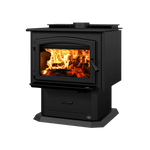
At a glance
- Type: Wood stove, EPA 2020 certified
- Heats: 1,000–2,700 sq ft
- Heat output: 110,000 BTU/hr
- Log length: 16 in east-west
- Efficiency: 71% HHV / 76% LHV
- Burn time: Up to 10 hours
- Chimney: 6 in, top vent
Description
The Osburn 3500 Wood Stove is an EPA 2020 certified wood stove for 1,000 to 2,700 sq ft. It burns up to 10 hours on a load and takes a 6-inch, top vent chimney.
Who it's for
Right buyer. Owners of moderately to well-insulated homes between roughly 1,500 and 2,200 sq ft who want serious heat output from a wood-burning appliance, are willing to load wood every four to six hours when running the stove hard, and have access to seasoned hardwood at 15–20% moisture content.
Wrong buyer. Not for buyers who want set-and-forget heating. Wood stoves require active operation: lighting, monitoring stove-top temperature, closing the air at the right moment, deciding when to reload.
How it performs
The 110,000 BTU/hr figure is a maximum-output rating based on dry cordwood at high loading density and short reload intervals. It is real, but it is a peak rating, not the average output across a full burn cycle of normal operation.
Good to know
- Non-catalytic burn time. A non-cat stove gives you simpler operation and no catalyst to replace, but you pay for it with shorter burns.
- Wood loading is a daily activity.
- Reload technique matters.
Specifications
Dimensions
Dimensions from the specification sheet
| Measurement | Value |
|---|---|
| Overall height | 34‑3/4" |
| Overall width | 28‑7/8" |
| Overall depth | 33‑1/2" |
| Shipping weight | 524 to 549 shipping (dealer copies differ) lb |
| Glass, W x H | 18‑7/8 x 11‑3/4 |
| Door opening | 19 W x 9‑7/8 H |
| Firebox, W x H x D | 22‑7/8 W x 12‑7/8 H x 20‑1/8 D |
Dimensions
| Measurement | Value |
|---|---|
| Firebox volume | 3.5 ft³ overall / 2.88 ft³ EPA |
| Firebox glass surface | 18 7/8" x 11 3/4" |
| Shipping weight | 549 lb |
Where it can go
The 3500 is designed for indoor installation in a permitted residential space with a Class A insulated chimney or a properly lined masonry chimney. It is approved for mobile-home installation only when the manual's mobile-home requirements are met, including outdoor combustion air, insulated intake pipe, double-wall venting, attachment to the structure, and no sleeping-room installation. It is approved for alcove installation with the manual's reduced-ceiling clearances. It is not an outdoor appliance. Garage, shop, cabin, non-residential, or otherwise unusual installations should be cleared with the AHJ, insurer, and authorized installer before purchase.
Clearances to combustibles
Floor protection
A continuous non-combustible ember-protection surface is required on combustible flooring. Steel of at least 0.015" thickness, cement board, brick, tile over a continuous non-combustible sheet, or another approved listed material may be used. Tile alone is not sufficient — the manual requires a continuous non-combustible sheet beneath any tile installation to prevent embers from falling through if cracks or grout separation occur. The pad must follow the manual's floor-protection diagram: in the USA, 16 inches in front of the door opening and 8 inches of side ember protection; in Canada, 18 inches in front and 8 inches on the other sides, subject to the manual notes and local code. A standard non-combustible ember-protection pad is sufficient — no insulating (R-rated) hearth pad is required.
Clearances
United States figures, in inches. The rating plate on the appliance overrides any published number; the installer confirms on site.
| Clearance | Minimum |
|---|---|
| Back wall, single-wall pipe | 13" |
| Back wall, double-wall pipe | 6" |
| Corner, single-wall pipe | 7‑1/4" |
| Corner, double-wall pipe | 7" |
| Side wall | 14" |
| Ceiling, from the floor the stove sits on | 84" |
Notes from the manual
The certification label on the back of the stove is the binding clearance for any installation. Reduced clearances are available with approved heat shields per the manual. Most installers default to double-wall connector pipe to gain the closer back-wall clearance.
Documents
- Osburn 3500 wood stove install & owner's manual (PDF - 6.2 MB)
- Wood stove manual | Safety notifications & general information (PDF - 2.9 MB)
- Osburn 3500 dimensions (PDF - 0.4 MB)
- Maximum recommended heating area by climate zone (PDF)
- Osburn wood products brochure, USA edition, with dimension drawings (PDF)
- Osburn limited lifetime warranty
- EPA test reports
- Replacement parts
Details
| Combustion technology | Non-catalytic |
|---|---|
| Firebox volume | 3.5 ft³ overall / 2.88 ft³ EPA |
| Maximum heat output | 110,000 BTU/hr |
| Tested output range | 17,200–57,800 BTU/hr |
| Heating range | 1,000–2,700 sq ft |
| Average efficiency | 71% HHV / 76% LHV |
| Particulate emissions | 1.6 g/hr |
| Maximum burn time | Up to 10 hours |
| Recommended log length | 16 in east-west |
| Maximum log length | 22 in east-west |
| Construction | Carbon steel |
| Baffle | C-Cast |
| Firebox glass surface | 18 7/8" x 11 3/4" |
| Door overlay | Black or brushed nickel |
| Blower | 130 CFM, included |
| Flue connection | 6 in, top vent |
| Shipping weight | 549 lb |
| Mobile home approved | Yes |
| Alcove install approved | Yes |
| Country of origin | Made in Canada |
| Model | OB03500 |
| Manufacturer | Osburn, by Stove Builder International (SBI), Quebec, Canada |
| Certification | UL 1482, UL 737, ULC S627; EPA 2020 |
| Warranty | Limited lifetime |
| Specification source | SBI specification table as published by Osburn dealers (thetorchguys.com, flameauthority.com, ruralenergy.com), 2026 |
Warranty
A one-time replacement limit applies to all parts with lifetime coverage. Warranty is void if the unit is used to burn anything other than seasoned cordwood, or if it is not operated according to the owner's manual. Damage caused by misuse, improper installation, lack of maintenance, overfiring, downdrafts, venting problems, or under-estimated heating area is not covered.
Warranty claims are made through your Osburn dealer and remain subject to SBI/Osburn inspection, approval, and the current written warranty. Kaminos is the retailer for this stove and supports buyers through purchase; final warranty approval rests with SBI as the manufacturer. SBI's parts network is well-stocked — replacement bricks, baffle, secondary tubes, glass, gaskets, blower, and accessory kits are openly available at fair prices through the SBI dealer and parts vendor network.
Osburn may require photos or returned parts to support a claim; repair work covered by warranty requires prior manufacturer approval.
Coverage details can change by component and warranty revision; the current Osburn warranty controls.
Heat
From the specification sheet
| Spec | Value |
|---|---|
| Heating area | 1,000 to 2,700 sq ft |
| Maximum heat output | 110,000 BTU/h |
| Heat output range | 18,200 to 49,500 BTU/h |
| Efficiency | 71% HHV, 76.6% LHV average; 77% optimum |
| Burn time | 10 h |
| Firebox volume | 3.5 cu ft (EPA loading 2.84) |
| Log length | 22 in (loads over width and depth) |
| Emissions | 1.32 g/h |
| Blower | 130 CFM included |
| Spec | Value | What it means |
|---|---|---|
| Combustion technology | Non-catalytic | Secondary-air tubes reignite smoke gases. No catalyst to replace; one air-control lever; simpler operation than a cat stove but shorter low-and-slow burn times. |
| Maximum heat output | 110,000 BTU/hr | Peak output on dry cordwood, transient. Sustained output across a burn cycle is substantially lower. |
| Heating range | 1,000–2,700 sq ft | Manufacturer's stated range. Real-world comfort sizing is 1,500–2,200 sq ft in moderate climates and lower in cold climates or older homes — depends on insulation, layout, climate, ceiling height, fuel quality, and installation. |
| Average efficiency | 71% HHV / 76% LHV | HHV is the federal standard and the figure the EPA database publishes. Optimum efficiency at low burn rate is 77% (LHV). |
| Particulate emissions | 1.6 g/hr | EPA 2020 limits are 2.0 g/hr for crib-wood testing or 2.5 g/hr for cordwood testing. The 3500 is listed as compliant with the 2020 cordwood standard. |
| Maximum burn time | Up to 10 hours | Manufacturer maximum from a packed load of dry hardwood with the air shut down hard. Useful heat through a burn cycle is realistically 6–8 hours. |
| Recommended log length | 16 in east-west | Per manual. Most firewood suppliers cut to this length. |
| Maximum log length | 22 in east-west | Longer logs go east-west (sides visible). Shorter splits can be loaded over depth, north-south, which most owners prefer for overnight loads. |
Choices and prices
Options
The unit price is Osburn's 2026 list price for the wood stove alone. Options sold on this page add to it; those marked on request we add to your order by hand.
Door overlay
| Door overlay | Part | Price |
|---|---|---|
| BLACK DOOR OVERLAY | OA10163 | $110 |
| BRUSHED NICKEL DOOR OVERLAY | OA10164 | $330 |
Base
| Base | Part | Price |
|---|---|---|
| 5"Ø FRESH AIR INTAKE KIT FOR WOOD STOVE ON PEDESTAL (on request) | AC01336 | $120 |
Fresh air
| Fresh air | Part | Price |
|---|---|---|
| 5''Ø FRESH AIR INTAKE REGISTER WITH AIRTIGHT DAMPER (on request) | AC01349 | $285 |
| 5"Ø X 4' INSULATED FLEX PIPE FOR FRESH AIR INTAKE (on request) | AC02090 | $50 |
Other options
| Other options | Part | Price |
|---|---|---|
| RIGID FIRESCREEN (on request) | AC01281 | $200 |
| GLASS ASH LIP (on request) | OA10166 | $220 |
What arrives
- Osburn 3500 stove with welded carbon-steel firebox and pedestal base
- Cast-iron arched door
- Choice of cast-iron door overlay: black or brushed nickel — one is required to complete the unit
- 130 CFM variable-speed blower with included thermodisc heat sensor for automatic on/off
- Airmate convection plate
- C-Cast baffle and stainless-steel secondary-air tube assembly
- Refractory firebrick lining
- Pull-out ash drawer
- Owner's installation and operation manual and product documentation
Sold separately
- Class A insulated chimney or stainless-steel masonry liner, sized for 6-inch flue
- Connector pipe (indoor stove pipe between stove top and Class A chimney) — double-wall preferred
- Hearth pad sized to manual specifications
- Optional rigid firescreen
- Optional glass ash lip
- Optional 5-inch fresh-air intake kit — required for mobile-home installs, recommended for tight homes with strong exhaust appliances
- Stove-top or flue thermometer — strongly recommended; not optional in practice
- Pin-type wood moisture meter
- Installation by an authorized qualified technician — required for warranty coverage and often required by code, permit, or insurance
Installation
Chimney requirements from the specification sheet
| Requirement | Value |
|---|---|
| Flue | 6 in |
| Chimney type | CAN/ULC S629, UL 103 HT |
| Minimum chimney height | 15 ft |
| Alcove installation | yes |
| Mobile home installation | yes, with fresh air intake |
The 3500 performs best on a 6-inch flue. For new installations, a UL 103 HT (USA) or ULC S629 (Canada) Class A insulated chimney is required. Per the manual: minimum 12 feet from the stove top to the exterior chimney termination, and total system height from the floor on which the appliance sits to the top of the chimney must never be less than 15 feet. A code-compliant masonry chimney may use either a clay liner or a suitably listed stainless-steel liner.
If the chimney is not 6 inches, the manual allows only limited exceptions: at least 5 inches in Canada only, or no more than 7 inches, and only when proper venting is verified and authorized by a qualified installer; otherwise use 6 inches. If a square or rectangular masonry liner is larger in cross-sectional area than a round 6-inch flue, the manual says it should be relined with a listed 6-inch stainless liner. On tall chimneys (over roughly 25–30 feet), some owners install a key damper to manage overdraft.
Outside air
Required for mobile-home installation. In conventional homes, the manual identifies room air as the safest and most reliable supply for combustion; almost all houses have enough natural leakage to provide what the stove needs. Outside air should be specified by the installer or used where exhaust appliances such as range hoods, dryers, or HRVs create depressurization that affects draft or causes smoke spillage. A smoke detector and carbon monoxide detector are required in the room where the stove is installed.
Codes and approvals
Code compliance for any specific installation is determined by the local Authority Having Jurisdiction. Manufacturer listings cover what the stove is approved for; the AHJ approves what is permitted at your address. Confirm local requirements before purchasing — particularly in EPA non-attainment counties and in HOA jurisdictions where new wood-burning installs may be restricted.
California Proposition 65
This product can expose you to chemicals including carbon monoxide, which is known to the State of California to cause cancer, birth defects or other reproductive harm. For more information go to www.P65warnings.ca.gov.
Planning the install
- Check with your building department and insurer: wood appliances need a permit in most places and an inspection after installation.
- The chimney is the other half of the system. It is sold separately and quoted from your installer's plan.
- Clearances and floor protection come from the manual and depend on the pipe and shields you choose. Send us your plan and we will check it.
- Burn seasoned wood below 20 percent moisture. Wet wood is the cause of most complaints about any wood stove.
- Special-order goods ship by freight.
Questions
How does it compare with the other Osburn models?
- Enerzone Solution 3.5 Mechanically identical SBI chassis — same firebox, same blower, same baffle, same emissions and efficiency, same warranty. Different cosmetic detailing in Enerzone's design language. Choose this if you prefer the Enerzone aesthetic; performance is the same. Drolet HT3000 The budget sibling on the same SBI lineage. Same firebox and chassis architecture in a plain steel jacket without the Osburn cast-iron door overlay or finish work. Blower not always included on the HT3000. Choose this if you want the working stove without the Osburn brand premium and don't need a factory blower.
- Pacific Energy Super 27 Cross-brand competitor in the 2.5 ft³ class. Smaller firebox, well-regarded operation and draft tolerance, strong North American dealer network. Choose this for a smaller home or for the Pacific Energy build philosophy; choose the Osburn 3500 for more output and larger log capacity. Blaze King Princess (catalytic) Different category — catalytic technology, thermostatic air control, and 12–30 hour low-output burn potential. Choose this if your priority is overnight burn time, controllability, or off-grid heating with fewer reloads. Higher price, requires catalyst monitoring and eventual replacement, longer learning curve. The Osburn 3500 wins on simplicity, peak heat output, and dealer/parts accessibility.
- Lopi Cape Cod Premium hybrid-catalytic stove in the same heating-area class. More technology, higher price, longer burn potential than the 3500. Choose this for premium aesthetics and longer burns; choose the 3500 for simpler operation and wider parts availability.
What chimney does it take?
A 6-inch flue: a listed factory-built chimney rated UL 103 HT in the US or ULC S629 in Canada, or a lined masonry chimney in good repair. The connector pipe and chimney are quoted from your installer's plan.
Does it need a blower?
No. Every Osburn heats by radiation and natural convection. The optional blower moves warm air into the room faster and helps in a larger or open space; it needs a 120-volt outlet.
Can I install it myself?
Many owners do the placement and the pipe with the manual in hand, but the chimney, the permit and the inspection are where an installer earns the fee. Insurance usually requires the inspection.
Can I return it?
Stoves ship by freight. Confirm the model and the options with us before you order, and contact us before returning anything.
What wood should I burn?
Seasoned hardwood, split and dried a year or more, below 20 percent moisture. Wet wood smokes, coats the chimney with creosote and makes a poor fire.
If you have any questions about this product, please let us know by filling out the form below, and we will contact you as soon as possible.
- Choosing a selection results in a full page refresh.