


Osburn Gusto Wood Burning Cook Stove
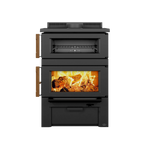
At a glance
- Type: Wood cook stove, EPA 2020 certified
- Heats: 500–2,100 sq ft
- Heat output: 75,000 BTU/hr
- Log length: 16 in east-west
- Efficiency: 76% HHV / 81% LHV
- Burn time: Up to 8 hours
- Chimney: 6 in
Description
The Osburn Gusto Wood Burning Cook Stove is an EPA 2020 certified wood cook stove for 500 to 2,100 sq ft. It burns up to 8 hours on a load and takes a 6-inch chimney.
Who it's for
Right buyer. Owners of cabins, cottages, off-grid homes, and rural kitchens who will actually cook on a wood appliance during heating season — not just in a power outage — and who want a modern cookstove with EPA 2020 cordwood compliance, glass on both doors, mobile-home approval, and the parts and dealer support of Stove Builder International's North American network.
Mobile-home and dual-purpose-room friendly with the optional fresh-air intake kit, double-wall connector pipe, and structural attachment per the manual.
How it performs
The 75,000 BTU/hr figure on the spec sheet is a maximum-output rating based on dry cordwood at high loading density and short reload intervals. It is real, but it is a peak rating, not the average output across a full burn cycle of normal cooking-mode operation.
Good to know
- A cookstove costs more than a heater of similar BTU output.
- Install location is locked to the kitchen zone. A heating stove can go in a basement, a back room, a corner of a great room.
- One-season learning curve.
Specifications
Dimensions
Dimensions from the specification sheet
| Measurement | Value |
|---|---|
| Overall height | 41‑7/8" |
| Overall width | 29‑3/8" |
| Overall depth | 29" |
| Shipping weight | 575 shipping lb |
| Glass, W x H | 18‑5/8 x 8‑1/4 |
| Door opening | 20 W x 9 H |
| Firebox, W x H x D | 21 W x 11‑7/8 H x 16‑1/2 D |
Dimensions
| Measurement | Value |
|---|---|
| Firebox volume | 2.26 ft³ overall / 1.94 ft³ EPA |
| Firebox glass surface | 18 5/8" x 8 1/4" |
| Oven glass | 18 9/16" x 5 7/8" |
| Shipping weight | 575 lb |
Where it can go
The Gusto is designed for indoor installation in a permitted residential space — a kitchen, dining room, mudroom, sunroom, or great room with adjacent kitchen function. It is approved for mobile-home installation only when the manual's mobile-home requirements are met, including outdoor combustion air, insulated intake pipe, double-wall venting, attachment to the structure, and no sleeping-room installation. It is not approved for alcove installation, factory-built (prefab) fireplace installation, or outdoor or unconditioned-space installation.
Clearances to combustibles
Floor protection
A continuous non-combustible ember-protection surface is required on combustible flooring. Steel of at least 0.015" thickness, cement board, brick, sealed-grout ceramic tiles over a continuous non-combustible sheet, or another approved listed material may be used. Tile alone is not sufficient — the manual requires a continuous non-combustible sheet beneath any tile installation.
The pad must follow the manual's floor-protection diagram: in the USA, 16 inches in front of the door opening and 8 inches of side ember protection; in Canada, 18 inches in front and 8 inches on the other sides, subject to the manual notes and local code. Most installers extend the pad farther forward (24–36 inches) for cooking ergonomics, since the working zone in front of the oven is part of the cooking workspace. A standard non-combustible ember-protection pad is sufficient — no insulating (R-rated) hearth pad is required.
Clearances
The certification label on the back of the cookstove is the binding clearance for any installation. Reduced clearances are available with approved heat shields per the manual. Most installers default to double-wall connector pipe to gain the closer back-wall clearance. For mobile-home installations, use the manual's mobile-home clearance table: double-wall pipe is required, and platform-to-ceiling clearance is 84", not 72".
Documents
- Wood Burning Cookstove Installation & Operating Manual (PDF - 9.4 MB)
- Molding Installation Instructions (PDF - 2.6 MB)
- Gusto Dimensions (PDF - 0.6 MB)
- Maximum recommended heating area by climate zone (PDF)
- Osburn wood products brochure, USA edition, with dimension drawings (PDF)
- Osburn limited lifetime warranty
- EPA test reports
- Replacement parts
Details
| Combustion technology | Non-catalytic |
|---|---|
| Firebox volume | 2.26 ft³ overall / 1.94 ft³ EPA |
| Maximum heat output | 75,000 BTU/hr |
| Tested output range | 14,300–47,300 BTU/hr |
| Heating range | 500–2,100 sq ft |
| Average efficiency | 76% HHV / 81% LHV |
| Particulate emissions | 2.0 g/hr |
| Maximum burn time | Up to 8 hours |
| Recommended log length | 16 in east-west |
| Maximum log length | 20 in east-west |
| Oven (interior) | 18" W x 15 5/16" D x 7 7/8" H |
| Cooktop | Cast iron, painted |
| Center molding | Black or brushed nickel |
| Baffle | C-Cast |
| Firebox glass surface | 18 5/8" x 8 1/4" |
| Oven glass | 18 9/16" x 5 7/8" |
| Blower | 130 CFM, optional |
| Flue connection | 6 in |
| Shipping weight | 575 lb |
| Mobile home approved | Yes |
| Alcove install approved | No |
| Country of origin | Made in Canada |
| Model | OB02047 |
| Manufacturer | Osburn, by Stove Builder International (SBI), Quebec, Canada |
| Certification | UL 1482, UL 737, ULC S627; EPA 2020 |
| Warranty | Limited lifetime |
| Specification source | SBI specification table as published by Osburn dealers (ruralenergy.com, flameauthority.com), 2026 |
Warranty
A one-time replacement limit applies to all parts with lifetime coverage. Warranty is void if the unit is used to burn anything other than seasoned cordwood, or if it is not operated according to the owner's manual. Damage caused by misuse, improper installation, lack of maintenance, overfiring, downdrafts, venting problems, or under-estimated heating area is not covered. Improper installation by anyone other than an authorized qualified technician voids the warranty.
Warranty claims are made through your Osburn dealer and remain subject to SBI/Osburn inspection, approval, and the current written warranty. Kaminos is the retailer for this cookstove and supports buyers through purchase; final warranty approval rests with SBI as the manufacturer. SBI's parts network is well-stocked — replacement bricks, baffle, secondary tubes, glass, gaskets, blower, and accessory kits are openly available at fair prices through the SBI dealer and parts vendor network.
Osburn may require photos or returned parts to support a claim; repair work covered by warranty requires prior manufacturer approval.
Coverage details can change by component and warranty revision; the current Osburn warranty controls.
Heat
From the specification sheet
| Spec | Value |
|---|---|
| Heating area | 500 to 2,100 sq ft |
| Maximum heat output | 75,000 BTU/h |
| Efficiency | 76% HHV, 81% LHV average; 83% optimum |
| Firebox volume | 2.26 cu ft (EPA loading 1.94) |
| Log length | 20 in (16 in recommended) |
| Emissions | 2.0 g/h |
| Oven | Stainless steel oven with a two-position rack and built-in thermometer; boils a liter of water in under 20 minutes |
| Spec | Value | What it means |
|---|---|---|
| Combustion technology | Non-catalytic | Secondary-air tubes reignite smoke gases. No catalyst to replace; one air-control lever controlling primary and secondary air simultaneously; simpler operation than a cat stove but shorter low-and-slow burn times. |
| Maximum heat output | 75,000 BTU/hr | Peak output on dry cordwood, transient. Sustained output across a burn cycle is substantially lower. |
| Heating range | 500–2,100 sq ft | Manufacturer's stated range. Real-world comfort sizing for primary heat is roughly 1,000–1,800 sq ft in moderate climates and lower in cold climates or older homes — depends on insulation, layout, climate, ceiling height, fuel quality, and installation. |
| Average efficiency | 76% HHV / 81% LHV | 83% optimum efficiency at low burn rate (LHV). Excellent for the cookstove category — most legacy cookstoves run 50–65% real efficiency. HHV is the federal standard. |
| Particulate emissions | 2.0 g/hr | EPA 2020 cordwood certified, not just EPA-exempt. Most cookstoves are exempt from EPA NSPS by category and never go through cordwood testing; SBI tested and certified the Gusto to the same standard as a modern heating stove. |
| Maximum burn time | Up to 8 hours | Manufacturer maximum from a packed load of dry hardwood with the air shut down hard. Useful baking and cooking output is realistically a 60–90 minute hot-and-steady window per load, with one small reload at the 30-minute mark for longer bakes. |
| Recommended log length | 16 in east-west | Per manual. Most firewood suppliers cut to this length. EPA testing was at 17 in. |
| Maximum log length | 20 in east-west | Useful margin over standard supplier cuts. Cookstove operators often keep a separate pile of small straight splits (3–4 in) for cooking-mode use. |
Choices and prices
Options
The unit price is Osburn's 2026 list price for the wood cook stove alone. Options sold on this page add to it; those marked on request we add to your order by hand.
Base
| Base | Part | Price |
|---|---|---|
| 5"Ø FRESH AIR INTAKE KIT FOR WOOD STOVE ON LEGS (on request) | AC01211 | $220 |
Blower
| Blower | Part | Price |
|---|---|---|
| 130 CFM BLOWER WITH VARIABLE SPEED CONTROL (THERMODISC INCLUDED) (on request) | AC01000 | $399 |
Fresh air
| Fresh air | Part | Price |
|---|---|---|
| 5''Ø FRESH AIR INTAKE REGISTER WITH AIRTIGHT DAMPER (on request) | AC01349 | $285 |
| 5"Ø X 4' INSULATED FLEX PIPE FOR FRESH AIR INTAKE (on request) | AC02090 | $50 |
Other options
| Other options | Part | Price |
|---|---|---|
| BLACK DECORATIVE MOLDING | OA10268 | $220 |
| BRUSHED NICKEL DECORATIVE MOLDING | OA10269 | $385 |
| 8 1/2" X 8 1/2" STEATITE COOKING PLATES (2 UNITS) (on request) | AC01212 | $130 |
| TEMPERED GLASS HEARTH PAD 10 mm - 54" X 46 3/4" (on request) | AC02703 | $869 |
| MODULAR FLOOR PROTECTION SYSTEM 54" X 46 3/4" (on request) | AC02711 | $545 |
| TINTED TEMPERED GLASS HEARTH PAD 10 mm - 54" X 46 3/4" (on request) | AC02758 | $439 |
| 60" X 64 1/8" CERTIFIED MODULAR HEAT SHIELD SYSTEM (on request) | AC02765 | $900 |
| EXTENSION FOR AC02711 MODULAR FLOOR PROTECTION SYSTEM (on request) | AC02785 | $200 |
| MODULAR HEARTH PAD SYSTEM 60" - CORNER (on request) | AC02787 | $775 |
| ROUND 4L DUTCH OVEN (GRAY) (on request) | AC09210 | $299 |
| GLASS ASH LIP (on request) | OA10132 | $165 |
What arrives
- Gusto cookstove with cast-iron painted cooktop, glass-fronted firebox door, glass-fronted oven door, and integrated 150–750 °F oven thermometer
- Stainless-steel oven (18" W × 15 5/16" D × 7 7/8" H) with removable cooking grill
- Decorative center molding in black (standard) or brushed nickel (configurable upgrade at order)
- C-Cast baffle and stainless-steel secondary-air tube assembly
- Refractory firebrick lining
- Pull-out ash drawer
- Universal chimney connector spigot, with adapter for double-wall pipe
- Removable wood-handle air control lever and wooden door handles
- Owner's installation and operation manual and product documentation
Sold separately
- Class A insulated chimney or stainless-steel masonry liner, sized for 6-inch flue
- Connector pipe (indoor stove pipe between the cookstove and the Class A chimney) — double-wall preferred, required for mobile-home installs
- Hearth pad sized to manual specifications, with continuous non-combustible sheet beneath any tile, extended forward for cooking ergonomics
- Optional 130 CFM blower kit with thermodisc — not included in the base price; recommended for open-plan rooms where heat distribution matters
- Optional 5-inch fresh-air intake kit — required for mobile-home installs, strongly recommended for tight kitchens with a powerful range hood
- Stove-top or flue thermometer for managing the firebox burn rate
- Internal oven probe thermometer for serious baking — the oven dial is approximate and reads ±50–100 °F off across the cookstove category generally
- Pin-type wood moisture meter
- Installation by an authorized qualified technician (WETT, NFI, or CSIA certified) — required for warranty coverage and often required by code, permit, or insurance
Installation
Chimney requirements from the specification sheet
| Requirement | Value |
|---|---|
| Flue | 6 in |
| Chimney type | CAN/ULC S629, UL 103 HT |
| Minimum chimney height | 12 ft |
| Alcove installation | no |
| Mobile home installation | yes, with fresh air intake |
The Gusto takes a 6-inch flue and requires 0.05" H₂O (12 Pa) of draft. For new installations, a UL 103 HT (USA) or ULC S629 (Canada) Class A insulated chimney is required. Per the manual: minimum 12 feet from the cookstove top to the exterior chimney termination. The chimney must extend at least 3 feet above the highest point of contact with the roof, and at least 2 feet above any roof line or obstacle within 10 feet horizontally. The cookstove may also be connected to a code-compliant masonry chimney with either a clay liner or a suitably listed stainless-steel liner; if the masonry liner is square or rectangular and larger in cross-section than a round 6-inch flue, the manual says it should be relined with a listed 6-inch stainless liner.
Outside air
The manual requires the room to have an outside or fresh-air inlet at least 5 inches in diameter for proper draft. The fresh-air intake kit (sold separately) is mandatory for mobile-home installation, and is the cleanest solution for tight new-construction kitchens or kitchens with a powerful range hood — range-hood depressurization is a real risk in cookstove installs and can pull smoke out of the firebox or back-draft the chimney. Install it if the kitchen has a high-CFM hood, an HRV, a tight building envelope, or any combination of those. A smoke detector and carbon monoxide detector are required in the room where the cookstove is installed.
Codes and approvals
Code compliance for any specific installation is determined by the local Authority Having Jurisdiction. Manufacturer listings cover what the cookstove is approved for; the AHJ approves what is permitted at your address. The Gusto's EPA 2020 cordwood certification is unusual in the cookstove category and matters in jurisdictions where local rules go beyond the federal cookstove exemption. Confirm local requirements before purchasing — particularly in EPA non-attainment counties and in HOA jurisdictions where new wood-burning installs may be restricted.
California Proposition 65
This product can expose you to chemicals including carbon monoxide, which is known to the State of California to cause cancer, birth defects or other reproductive harm. For more information go to www.P65warnings.ca.gov.
Planning the install
- Check with your building department and insurer: wood appliances need a permit in most places and an inspection after installation.
- The chimney is the other half of the system. It is sold separately and quoted from your installer's plan.
- Clearances and floor protection come from the manual and depend on the pipe and shields you choose. Send us your plan and we will check it.
- Burn seasoned wood below 20 percent moisture. Wet wood is the cause of most complaints about any wood stove.
- Special-order goods ship by freight.
Questions
How does it compare with the other Osburn models?
Enerzone Pyra Mechanically identical SBI chassis — same firebox, same oven, same blower option, same baffle, same emissions and efficiency, same warranty. Different cosmetic detailing in Enerzone's design language with fluted cast-iron columns and a single sculpted black wooden handle. Choose this if you prefer the Enerzone aesthetic; performance is the same. J.A. Roby Cuisinière 3.0 Quebec-built competitor with a larger firebox, higher rated BTU, integrated food warmer above the oven, and mobile-home approval. EPA-exempt as a cookstove (not 2020 cordwood certified). Choose this for more cooking volume and warming-shelf capacity; choose the Gusto for the certification stack and the dual glass.
Pioneer Princess (Suppertime) Amish-built USA cookstove with optional 9-gallon water reservoir, thermostatic primary air, porcelain enamel finish, no glass on firebox or oven, EPA-exempt, not mobile-home approved. The traditional homestead choice for buyers who want a wood appliance to also handle domestic hot water. Choose this for off-grid water heating; choose the Gusto for glass, modern certification, and mobile-home compatibility. Esse Ironheart UK-built premium range cooker with a 50-litre oven and a six-pan "dog bone" hotplate, multifuel-capable. Roughly 1.5–2× the Gusto's price, longer learning curve, smaller heating envelope. Choose this for the British range-cooker experience; choose the Gusto for North American support, lower price, and EPA 2020 certification.
What chimney does it take?
A 6-inch flue: a listed factory-built chimney rated UL 103 HT in the US or ULC S629 in Canada, or a lined masonry chimney in good repair. The connector pipe and chimney are quoted from your installer's plan.
Does it need a blower?
No. Every Osburn heats by radiation and natural convection. The optional blower moves warm air into the room faster and helps in a larger or open space; it needs a 120-volt outlet.
Can I install it myself?
Many owners do the placement and the pipe with the manual in hand, but the chimney, the permit and the inspection are where an installer earns the fee. Insurance usually requires the inspection.
Can I return it?
Stoves ship by freight. Confirm the model and the options with us before you order, and contact us before returning anything.
What wood should I burn?
Seasoned hardwood, split and dried a year or more, below 20 percent moisture. Wet wood smokes, coats the chimney with creosote and makes a poor fire.
If you have any questions about this product, please let us know by filling out the form below, and we will contact you as soon as possible.
- Choosing a selection results in a full page refresh.