


Osburn Matrix 1900 Wood Insert


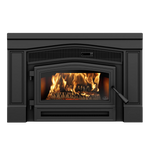
A 1.1 ft³ non-catalytic small wood insert built around a magnificent cast-iron decorative faceplate with patterned upper louver and framing columns. EPA 2020 cordwood certified at 1.5 g/hr particulate emissions with 75% HHV efficiency, 45,000 BTU/hr maximum output, 17-inch maximum east-west log capacity, up to 7-hour maximum burn time, and a 90 CFM heat-activated blower included as standard. Configurable Black or Brushed Nickel cast-iron door overlay. The Osburn-styled sibling of the Enerzone Destination 1.9. Choose the options below; the price updates as you go.
- Type: Wood insert, EPA 2020 certified
- Heats: 250–1,200 sq ft
- Heat output: 45,000 BTU/hr
- Log length: 16 in east-west
- Efficiency: 75% HHV / 80% LHV
- Burn time: Up to 7 hours
- Chimney: 6 in (insert liner)
- Made by: Osburn, by Stove Builder International, Quebec, Canada
Who it's for
Right buyer. Owners of an existing masonry fireplace who want real heat output instead of a decorative open fire, in a single main-floor room, an open-plan small home, a finished basement family room, or a cottage of roughly 500–900 sq ft, with reasonable insulation and access to seasoned hardwood at 15–20% moisture content. Suited to homeowners whose existing masonry opening is on the smaller side — the Matrix 1900's tapered top and sides plus 15 1/2" minimum hearth depth let it fit openings that exclude wider or deeper inserts.
The cast-iron decorative faceplate, patterned upper louver, framing columns, and recessed flush-mount blower with hidden air-control handle deliver a more finished face than most inserts in this category. Buyers who prefer the Osburn aesthetic — premium cast-iron detailing, Black or Brushed Nickel door overlay configurability — over the plainer Enerzone Destination 1.9, which uses the same chassis at a lower price.
Wrong buyer. Not for buyers who want set-and-forget heating. Wood-burning inserts require active operation: lighting, monitoring, closing the air at the right moment, deciding when to reload. The 1.1 ft³ firebox can leave usable coals after a long burn, but do not expect steady, high output through an entire night. Not for buyers expecting 8–14+ hour overnight burns. A small non-catalytic firebox gives you 3–4 hours of useful heat from a packed load of dense hardwood, occasionally up to 5 in mild weather. For longer burns, a catalytic or hybrid insert is the right tool. Not for whole-house primary heat in larger or older homes.
The manufacturer's stated 1,200 sq ft upper range is achievable only in well-insulated, open-plan, moderate-climate conditions; in real-world use this is a one-room or one-zone insert, not a whole-house heater. Not for prefab metal fireplaces — those need a different appliance entirely. Not approved for mobile-home or alcove installation. Not for buyers without a code-compliant masonry fireplace and chimney. The Matrix 1900 requires a continuous 6-inch stainless-steel chimney liner running the full height; that liner and its installation are not included in the appliance price.
Will it fit?
Minimum fireplace opening
Measure the inside of the firebox: width, height and depth. The insert needs at least this much, and the faceplate covers the rest of the old opening.
| Width | Height | Depth |
|---|---|---|
| 25" | 19" | 15‑1/2" |
At the back of the firebox: 21-1/2 W x 17-1/4 H at the back.
Dimensions from the specification sheet
| Measurement | Value |
|---|---|
| Overall height | 23‑7/8" |
| Overall width | 36" |
| Overall depth | 21" |
| Shipping weight | 332 shipping lb |
| Glass, W x H | 18 x 8‑1/8 |
| Door opening | 18‑1/4 W x 7‑7/8 H |
| Firebox, W x H x D | 16‑3/4 W x 8‑7/8 H x 12‑3/8 D |
Dimensions
| Measurement | Value |
|---|---|
| Firebox volume | 1.1 ft³ overall / 1.03 ft³ EPA |
| Glass | 18" x 8 1/8", ceramic |
| Door opening | 18 1/4" W x 7 7/8" H |
| Overall dimensions | 36" W x 21" D x 23 7/8" H |
| Shipping weight | 332 lb |
Where it can go
The Matrix 1900 is approved only for installation inside an existing code-compliant masonry fireplace with a continuous stainless-steel chimney liner. It is not approved for installation in factory-built (prefab) metal fireplaces, in mobile or manufactured homes, in alcoves, or as a freestanding unit. The masonry fireplace and chimney must be inspected before installation for cracks, loose mortar, creosote, blockage, or other signs of deterioration.
Clearances to combustibles
Floor protection
The hearth extension must be a continuous non-combustible surface in front of the door opening. Floor protection requirements depend on whether the existing masonry hearth is raised above the surrounding combustible floor and whether it extends sufficiently in front of the appliance. Tile alone is not sufficient — the manual requires a continuous non-combustible sheet beneath any tile installation. If the existing masonry hearth extension is long enough and raised more than 5 inches above the combustible floor, standard non-combustible ember protection may be sufficient. If the masonry hearth is level with, or only slightly raised above, the surrounding combustible floor, an R-value floor protector may be required per the manual's floor-protection worksheet. Final hearth protection must be calculated from the manual and approved by the installer/AHJ.
Clearances
United States figures, in inches. The rating plate on the appliance overrides any published number; the installer confirms on site.
| Clearance | Minimum |
|---|---|
| Combustible side wall | 16" |
| Combustible side mantel | 1" |
| Combustible top mantel | 1" |
| Ceiling, from the floor the stove sits on | 72" |
Notes from the manual
The certification label on the back of the insert always overrides clearance figures published elsewhere. Reduced clearances are not available by means of heat shields on this insert — the figures above are the binding minimums.
Heat and burn
From the specification sheet
| Spec | Value |
|---|---|
| Heating area | 250 to 1,200 sq ft |
| Maximum heat output | 45,000 BTU/h |
| Heat output range | 8,471 to 31,700 BTU/h |
| Efficiency | 75% HHV, 80% LHV average; 82% optimum |
| Burn time | 7 h |
| Firebox volume | 1.1 cu ft (EPA loading 1.03) |
| Log length | 17 in |
| Emissions | 1.5 g/h |
| Blower | 90 CFM included |
| Spec | Value | What it means |
|---|---|---|
| Combustion technology | Non-catalytic | Secondary-air tubes reignite smoke gases. No catalyst to replace; one air-control lever; simpler operation than a cat insert but shorter low-and-slow burn times. |
| Maximum heat output | 45,000 BTU/hr | Peak output on dry cordwood, transient. Sustained output across a burn cycle is substantially lower — the manufacturer's tested operating band lands well below this peak. |
| Heating range | 250–1,200 sq ft | Manufacturer's stated range. Real-world comfort sizing for primary heat is roughly 500–900 sq ft in moderate climates and lower in cold climates or older homes — depends on insulation, layout, climate, ceiling height, fuel quality, and installation. |
| Average efficiency | 75% HHV / 80% LHV | 82% optimum overall efficiency at low burn rate; 78% optimum heat transfer efficiency. HHV is the federal standard. Government incentives may apply by jurisdiction and installation date. |
| Particulate emissions | 1.5 g/hr | Per manufacturer's published spec table. EPA 2020 limits are 2.0 g/hr crib-wood or 2.5 g/hr cordwood. The Matrix 1900 is well below the federal cordwood limit. |
| Maximum burn time | Up to 7 hours | Manufacturer maximum at the lowest air setting. Useful heat through a burn cycle is realistically 3–4 hours, occasionally up to 5 in mild weather. |
| Recommended log length | 16 in east-west | Per manual. Most firewood suppliers cut to this length. |
| Maximum log length | 17 in east-west | Limited margin over the 16-inch standard supply cut. Verify your firewood supply before buying. Logs load across the width of the firebox, sides visible from the door. |
| Combustion chamber | 16 3/4" W x 12 3/8" D x 8 7/8" H | Inside firebox dimensions per manufacturer spec. Designed for east-west loading across the width of the firebox. The deep bottom of the combustion chamber allows ash to accumulate and reduces cleanout frequency. |
Choose your options
Options
The unit price is Osburn's 2026 list price for the wood insert alone. Options sold on this page add to it; those marked on request we add to your order by hand.
Door overlay
| Door overlay | Part | Price |
|---|---|---|
| BLACK DOOR OVERLAY | OA10041 | $110 |
| BRUSHED NICKEL DOOR OVERLAY | OA10042 | $275 |
Faceplate and trim
| Faceplate and trim | Part | Price |
|---|---|---|
| 32" X 44" CUTTABLE FACEPLATE (18 GA) (on request) | AC02082 | $220 |
Fresh air
| Fresh air | Part | Price |
|---|---|---|
| 5"Ø FRESH AIR INTAKE KIT (on request) | AC01298 | $100 |
| 5''Ø FRESH AIR INTAKE REGISTER WITH AIRTIGHT DAMPER (on request) | AC01349 | $285 |
| 5"Ø X 4' INSULATED FLEX PIPE FOR FRESH AIR INTAKE (on request) | AC02090 | $50 |
Other options
| Other options | Part | Price |
|---|---|---|
| RIGID FIRESCREEN (on request) | AC01213 | $210 |
| OFFSET LINER ADAPTER (on request) | AC01214 | $295 |
| LINER HOOK UP SYSTEM (on request) | AC02006 | $120 |
| TEMPERED GLASS HEARTH PAD 10 mm - 18" X 50" (on request) | AC02760 | $399 |
Chimney and installation
Chimney requirements from the specification sheet
| Requirement | Value |
|---|---|
| Flue | 6 in liner |
| Chimney type | Liner ULC-S635, CAN/ULC-S640, UL 1777 |
| Minimum chimney height | 12 ft |
| Mobile home installation | no |
| Flue center | 10‑5/8 in from the side, 5‑1/8 in from the back |
The Matrix 1900 requires a continuous 6-inch stainless-steel chimney liner extending from the insert flue collar to the top of the chimney. The liner must conform to ULC S635, CAN/ULC-S640 (Canada) or UL 1777 (USA) and be rated for solid fuel. The minimum liner height is 12 feet, subject to installer verification, certification label, draft conditions, and local code. The chimney must extend at least 3 feet above the highest point of contact with the roof and at least 2 feet above any roof line or obstacle within 10 feet horizontally.
The Matrix 1900 performs best with a 6-inch stainless-steel chimney liner. In the USA, use a 6-inch liner listed to UL 1777. In Canada only, connection to a chimney liner of at least 5 inches may be permitted if it properly vents combustion gases, the total masonry chimney height is greater than 20 feet, and the application is verified and authorized by a qualified installer. The insert is not approved for a positive flue connection to clay tile — a continuous stainless liner is required.
If the existing fireplace's throat damper is to remain, it must be locked open to clear the liner; otherwise the damper plate must be removed. A sheet-metal block-off plate sealed at the damper level (or, in Canada per CSA B365, mineral wool packing around the liner) is recommended at the throat to reduce cold-air backdraft and to allow the insert to deliver rated performance — without it, jacket-recovered heat is lost into the smoke chamber. An insulated liner (or pre-insulated liner with a wrap) improves draft and reduces creosote, and is required by code in some jurisdictions for clearance reasons.
Outside air
An optional 5-inch fresh-air intake kit is available for code jurisdictions requiring outside combustion air or for tight new-construction homes with mechanical ventilation. In conventional homes the manual identifies room air as the safest and most reliable supply for combustion; almost all houses have enough natural leakage to provide what the insert needs. A smoke detector and carbon monoxide detector are required in the room where the insert is installed.
Codes and approvals
Code compliance for any specific installation is determined by the local Authority Having Jurisdiction. Manufacturer listings cover what the insert is approved for; the AHJ approves what is permitted at your address. A WETT (Canada), NFI, or CSIA (USA) certified installer is strongly recommended and frequently required by code, permit, or insurance. In Canada the CSA B365 standard applies; in the USA, ANSI NFPA 211 applies. Confirm local requirements before purchasing — particularly in EPA non-attainment counties and in HOA jurisdictions where new wood-burning installs may be restricted.
California Proposition 65
This product can expose you to chemicals including carbon monoxide, which is known to the State of California to cause cancer, birth defects or other reproductive harm. For more information go to www.P65warnings.ca.gov.
What arrives
- Osburn Matrix 1900 wood insert (OB01900) with welded carbon-steel firebox and cast-iron glazed door
- Cast-iron decorative faceplate with patterned upper louver and framing columns (23 7/8" × 36")
- Configured at order with required door overlay selection — see "Where it can go" for the options
- 90 CFM premium-quality flush-mounted variable-speed tangential blower with rheostat speed control and thermodisc auto-on
- C-Cast baffle and stainless-steel secondary-air tube assembly
- Moulded refractory bricks lining
- Removable wood-grip air-control handle
- Liner fixation brackets and hardware
- Owner's manual and product documentation
Sold separately
- 6-inch continuous stainless-steel chimney liner kit (UL 1777, CAN/ULC-S635, or CAN/ULC-S640) — required for installation, sized to the chimney height
- Hearth extension or floor protector sized per manual specifications, with continuous non-combustible sheet beneath any tile
- Sheet-metal block-off plate, high-temp silicone, and mineral wool insulation — effectively required in practice for the insert to deliver rated performance
- Stainless offset elbow at the insert collar (15° or 30°) — needed on most installs where the masonry flue is offset from the insert
- Insulation wrap for the liner (or a pre-insulated liner) — strongly recommended for all installs, code-required in some
- Optional 32" × 44" cuttable faceplate, 18 GA (SBI AC02082) — for masonry openings larger than the standard faceplate covers
- Optional 5-inch fresh-air intake kit (SBI AC01298) — for code jurisdictions requiring outside combustion air or for tight new-construction homes
- Optional 5-inch × 4' insulated flex pipe for fresh-air intake (SBI AC02090) — HVAC type, ULC S110 or UL 181 class 0 or class 1
- Optional 5-inch fresh-air intake register with airtight damper (SBI AC01349) — do not close while in use
- Optional rigid firescreen (SBI AC01213) — for occasional attended fire viewing only where permitted by local code and only when used exactly as instructed in the fire screen manual; never leave the insert unattended when used with a fire screen
- Optional liner hook-up system (SBI AC02006) — simplifies liner-to-flue-collar connection
- Optional offset liner adapter (SBI AC01214) — for installations where the chimney throat geometry requires offset connection
- Optional tempered glass hearth pad 10mm 18" × 50" (SBI AC02760)
- Pin-type wood moisture meter — not optional in practice
Before you order
- Check with your building department and insurer: wood appliances need a permit in most places and an inspection after installation.
- The chimney is the other half of the system. It is sold separately and quoted from your installer's plan.
- Clearances and floor protection come from the manual and depend on the pipe and shields you choose. Send us your plan and we will check it.
- Burn seasoned wood below 20 percent moisture. Wet wood is the cause of most complaints about any wood stove.
- Special-order goods ship by freight.
How it performs
The 45,000 BTU/hr maximum is a peak rating, transient, achieved on dry cordwood with the air control fully open in the first hour or so of a high-burn cycle. It is real, but it is a peak rating, not the average output across a full burn cycle of normal operation. The figure that matters for daily life is the sustained output across a full burn cycle, which lands in the 8,471–31,700 BTU/hr band per the CSA B415.1-10 stack-loss method — a wide range covering shoulder-season heating on the low end and strong sustained output for cold-snap heating on the high end.
A realistic operating day in a well-insulated 600–800 sq ft open-plan room: morning reload on warm coals produces a fast 60-minute warm-up and 2–3 hours of strong output; mid-afternoon reload sustains heat through evening; a final pack at bedtime gives 3–4 hours of useful heat with the air shut down, leaving coals by morning. With seasoned oak, maple, hickory, or beech, expect 3–4 hours of useful heat per packed load; with birch, pine, or softer wood, 2–3.
The masonry around the insert acts as a thermal mass. Once the surrounding brick or stone is up to temperature, it continues radiating heat into the room well after the active fire has died down. The first hour from a cold start is the slowest because that mass has to come up to temperature; once it's hot, response time is faster.
The 17-inch maximum log capacity has limited margin over the 16-inch standard supplier cut. Confirm your firewood supply before buying — even a half-inch over forces awkward angled loading. The practical loading depth is closer to 14–15 inches once you account for the air gap behind the glass; nobody loads logs hard against the air-wash. Plan firewood cuts accordingly.
The included 90 CFM tangential blower meaningfully improves heat transfer from the air jacket into the room. Because most of the insert's firebox sits inside the masonry cavity, the radiant heat that would otherwise reach the room from a freestanding stove is partly absorbed by the surrounding brick. The convection jacket around the firebox captures that heat and the blower pushes it out into the room. The thermodisc handles automatic on/off based on insert temperature — set the rheostat and the sensor decides when the blower actually runs. The insert takes about an hour to reach blower-activation temperature from a cold start, then the sensor starts the blower automatically and shuts it off when the insert cools at the end of a burn. At lower settings the blower is unobtrusive; at higher settings it is audible. Blower noise is the most consistent owner complaint on this platform.
Air-wash glass stays largely clear during proper hot burns at moderate-to-high air settings. At low burn rates — particularly overnight loads with the air choked down — the small firebox produces less velocity over the glass than larger inserts, and tar will form on the lower edges and corners. This is universal to non-catalytic small inserts in this class, not specific to Osburn.
Power-failure operation: the insert continues to burn safely without electricity — only the blower stops. Heat distribution drops noticeably without the blower because the masonry cavity absorbs most of the firebox radiation. Plan accordingly if you're buying this insert specifically as a power-outage heat source.
Trade-offs to know
Small firebox, short burns. A 1.1 ft³ non-cat insert gives you simpler operation and lower up-front cost than a hybrid or catalytic, but you pay for it with shorter burns. If you want to load at 9 PM and have meaningful heat at 6 AM, this is not the right tool. Plan on reloading every 2–3 hours during active heating and accepting that overnight will end at coals.
The 1,200 sq ft figure is aspirational. The most consistent owner regret across small SBI inserts is buying for the high end of the manufacturer's heating range. If you need to reliably heat more than ~900 sq ft as primary winter heat, step up a firebox size — the Osburn 1700-I, Pacific Energy Super, or a hybrid all give meaningfully more usable heat for the same operational effort.
Flush insert depends on the blower. The Matrix 1900's flush design means most heat transfer to the room runs through the air jacket and out via the 90 CFM blower. Without the blower, output is largely radiant through the glass — usable, but a fraction of the rated convective performance. Buyers who want to heat without electricity dependence should consider a protruding insert or a freestanding stove.
Blower noise is a known complaint. Owner reports on this platform consistently cite blower vibration and audibility as the platform's most consistent weakness. SBI's design is intentional — slower, hotter air rather than higher CFM cool air — but at higher rheostat settings the blower is audible. Several owners report rattling at certain conditions; if vibration or hum develops, have the installer or dealer inspect blower mounting, clearances, and service parts rather than improvising modifications.
No ash lip on the flush design. The Matrix 1900 ships without an ash lip — common on flush inserts. Ash spilled at the door opening can be drawn into the blower intake. Plan for careful loading technique, a small hearth-side ash brush, and turning the blower OFF before opening the door fully.
Wood quality is not negotiable. The most common "the insert doesn't heat" complaint comes from owners running 22–25% moisture wood. The advanced combustion features only work in the 15–20% range. A pin-type moisture meter is the single best accessory for this insert.
Glass blackens at low burn rates. Universal to non-cat tube inserts in this firebox class. Daily hot cleanup burns and tolerance for a periodic wipe are part of operating this insert. Owners chasing always-clear glass on long, slow burns should look at catalytic technology.
Liner, block-off plate, and labor are not in the appliance price. The insert is the appliance; the chimney liner, the block-off plate, the insulation wrap, and the professional installation are separate purchases that need to be planned for. Older or taller chimneys, offset flues, and damper-frame removal add to install complexity. Skipping the liner, the block-off plate, or the insulation wrap saves money up front and costs measurable performance and creosote durability after.
Living with it
First burns. The first three to six fires release paint VOCs as the high-temperature stove paint cures. The smell can be strong; ventilate the room well and avoid prolonged exposure during cure-in. Run the insert hot and expect the smell to disappear permanently after the cure-in.
Lighting. The manual describes a top-down conventional method as effective on the Matrix 1900 — small splits at the base, smaller splits crossed over them, kindling on top, fire starter at the very top, light the top. Cleaner ignition, less smoke, faster to operating temperature. Leave the door slightly ajar for about 5 minutes during light-off; close once the fire is well established. The manual also describes an EPA-style loading procedure for cleanest combustion.
Air control. The control is located above the door and uses a removable wood-grip handle that clips into the lower louver. Slide the handle onto the air-control stem only when adjusting; do not leave it on during use, as the metal stem gets very hot. Full open at light-off; gradually closed only after the load is fully engaged and stable secondary flames are established. Closing too fast and the fire smolders. A flue thermometer is strongly recommended; without one, you are guessing at draft, burn rate, and overfire risk.
Reload cadence. 2–3 hours between reloads in active heating use; up to 4 hours for a final overnight pack with the air shut hard. Rake remaining charcoal toward the front of the firebox before loading — this concentrates the coals near where most of the combustion air enters and helps ignite the new load. Open the air for a minute or two before opening the door, open the door slowly to avoid smoke rollout, load, close the door, and run the air open until the load is fully engaged before reducing gradually. Turn the blower OFF before opening the door fully to reduce ash disturbance.
Burn in cycles, not single-log feeds. The manual is explicit: do not attempt to produce steady heat output by placing a single log on the fire at regular intervals. Always place at least three pieces on the fire at a time so the heat radiated from one piece helps ignite the pieces next to it. Each load should provide several hours of heating.
Carbon monoxide watch. Per the manual, if the firebox no longer shows flame but still contains unburned logs, check outside for smoke from the chimney. Smoke without flame means the fire is air-starved and CO levels are rising. Open the door slightly, move the logs with a poker, create a passage for air by making a trench in the ember bed, and add small kindling-size pieces to restart combustion.
Ash management. The Matrix 1900 uses a hollow-bottom firebox; ash is scooped manually from the front. The deep combustion-chamber bottom allows ash to accumulate longer than shallower designs, reducing cleanout frequency. The manual recommends emptying every 2–3 days during full-time heating. The best time to remove ash is in the morning after an overnight fire when the insert is relatively cool but there is still some chimney draft to draw ash dust into the insert rather than into the room. Always dispose of ash in a tightly covered metal container on a non-combustible surface, well away from combustible materials — ash retains hot embers for days and releases carbon monoxide. Never store ashes indoors, in a non-metallic container, or on a wooden deck.
Glass cleaning. Damp newspaper dipped in cold ash, or a dedicated ceramic-glass cleaner. Daily wipe during low-burn weather; weekly during high-burn. Black streaks at the lower edge mean wet wood; black uniformly across the glass means burns are running too cool. Brown stains at the lower corners mean smoky combustion. Do not clean the glass when the insert is hot, and do not strike or slam the glass door shut.
Specifications
| Combustion technology | Non-catalytic |
|---|---|
| Installation type | Masonry insert |
| Firebox volume | 1.1 ft³ overall / 1.03 ft³ EPA |
| Maximum heat output | 45,000 BTU/hr |
| Tested output range | 8,471–31,700 BTU/hr |
| Heating range | 250–1,200 sq ft |
| Average efficiency | 75% HHV / 80% LHV |
| Particulate emissions | 1.5 g/hr |
| Maximum burn time | Up to 7 hours |
| Recommended log length | 16 in east-west |
| Maximum log length | 17 in east-west |
| Construction | Carbon steel, cast-iron faceplate and door |
| Door overlay | Black or Brushed Nickel |
| Glass | 18" x 8 1/8", ceramic |
| Blower | Included, 90 CFM |
| Baffle | C-Cast |
| Flue connection | 6 in (insert liner) |
| Combustion chamber | 16 3/4" W x 12 3/8" D x 8 7/8" H |
| Door opening | 18 1/4" W x 7 7/8" H |
| Overall dimensions | 36" W x 21" D x 23 7/8" H |
| Minimum masonry opening | 19" H x 25" W x 15 1/2" D |
| Shipping weight | 332 lb |
| Mobile home approved | No |
| Country of origin | Made in Canada |
| Model | OB01900 |
| Manufacturer | Osburn, by Stove Builder International (SBI), Quebec, Canada |
| Certification | UL 1482, UL 737, ULC S628; EPA 2020 |
| Warranty | Limited lifetime |
| Specification source | SBI specification table as published by Osburn dealers (thetorchguys.com, buildwithrise.com), 2026 |
Warranty
A one-time replacement limit applies to all parts with lifetime coverage. Warranty is void if the unit is used to burn anything other than seasoned cordwood, or if it is not operated according to the owner's manual. Damage caused by misuse, improper installation, lack of maintenance, overfiring, downdrafts, venting problems, or under-estimated heating area is not covered. Improper installation by anyone other than an authorized qualified technician voids the warranty.
Warranty claims are made through your Osburn dealer and remain subject to SBI/Osburn inspection, approval, and the current written warranty. Kaminos is the retailer for this insert and supports buyers through purchase; final warranty approval rests with SBI as the manufacturer. SBI's parts network is well-stocked — replacement bricks, baffle, secondary tubes, glass, gaskets, and blower are openly available at fair prices through multiple parts vendors.
Osburn may require photos or returned parts to support a claim; repair work covered by warranty requires prior manufacturer approval.
Coverage details can change by component and warranty revision; the current Osburn warranty controls.
Questions people ask
How does it compare with the other Osburn models?
- Enerzone Destination 1.9 Wood Insert Mechanically identical SBI chassis — same 1.1 ft³ firebox, same 45,000 BTU/hr maximum, same 17-inch log capacity, same 90 CFM blower, same 75% HHV efficiency, same 1.5 g/hr emissions, same 7-hour burn time, same minimum masonry opening, same warranty schedule. The Destination 1.9 is the plainer Enerzone-branded sibling at a lower price point; the Matrix 1900 adds the cast-iron decorative faceplate with patterned upper louver and framing columns plus Black or Brushed Nickel door overlay configurability. Choose the Matrix 1900 for the Osburn finish detailing; performance is the same.
- Osburn 1700-I Wood Insert Step-up sibling in the Osburn insert line. Larger 1.86 ft³ firebox, 65,000 BTU/hr maximum, 500–1,800 sq ft heating range, 18-inch log capacity, 144 CFM blower, 68% HHV efficiency. Larger masonry opening required (21 1/2" × 27 1/2" × 12 7/8"). Configurable Regular/Large faceplate in Black or Brushed Nickel plus configurable door overlay. Choose the 1700-I for larger spaces and longer log capacity; choose the Matrix 1900 for smaller masonry openings, higher published efficiency, and the Matrix decorative faceplate aesthetic.
- Drolet Escape 1500-I Wood Insert SBI sibling under the Drolet brand. Larger 1.9 ft³ overall firebox at a lower price point, with the shallowest depth in class (12 3/4") and an 18-inch log capacity. Wider 27 1/2" minimum opening, so it won't fit some smaller hearths the Matrix 1900 will. Same SBI parent, same warranty schedule, plainer styling without the cast-iron decorative faceplate.
- Pacific Energy Neo 2.5 Wood Insert Cross-brand step-up. 2.0 ft³ firebox, premium build, sealed-firebox technology with single-lever non-cat operation, longer realistic 6–8 hour burns, better heat retention. Won't fit the smallest hearths and typically costs more delivered. The most-mentioned cross-shop on hearth-enthusiast forums when buyers compare to the Matrix 1900 — Pacific Energy fit-and-finish at a higher price point versus the SBI dealer/parts accessibility and the Osburn finish detailing.
What does it need in the chimney?
A 6-inch stainless liner run the full height of the existing chimney to a cap, sized and quoted from your installer's plan. The old chimney is inspected and cleaned first.
Does it need a blower?
No. Every Osburn heats by radiation and natural convection. The optional blower moves warm air into the room faster and helps in a larger or open space; it needs a 120-volt outlet.
Can I install it myself?
Many owners do the placement and the pipe with the manual in hand, but the chimney, the permit and the inspection are where an installer earns the fee. Insurance usually requires the inspection.
Can I return it?
Stoves ship by freight. Confirm the model and the options with us before you order, and contact us before returning anything.
What wood should I burn?
Seasoned hardwood, split and dried a year or more, below 20 percent moisture. Wet wood smokes, coats the chimney with creosote and makes a poor fire.
How often does the chimney need sweeping?
Once a year at least, and after every cord or two if you burn nightly.
Can it go in a mobile home or an alcove?
The specification table on this page says whether the model is approved for a mobile home, with the fresh-air kit, and for an alcove, with the alcove clearances in the manual.
If you have any questions about this product, please let us know by filling out the form below, and we will contact you as soon as possible.
- Choosing a selection results in a full page refresh.