Regency Liberty Gas Insert
Couldn't load pickup availability
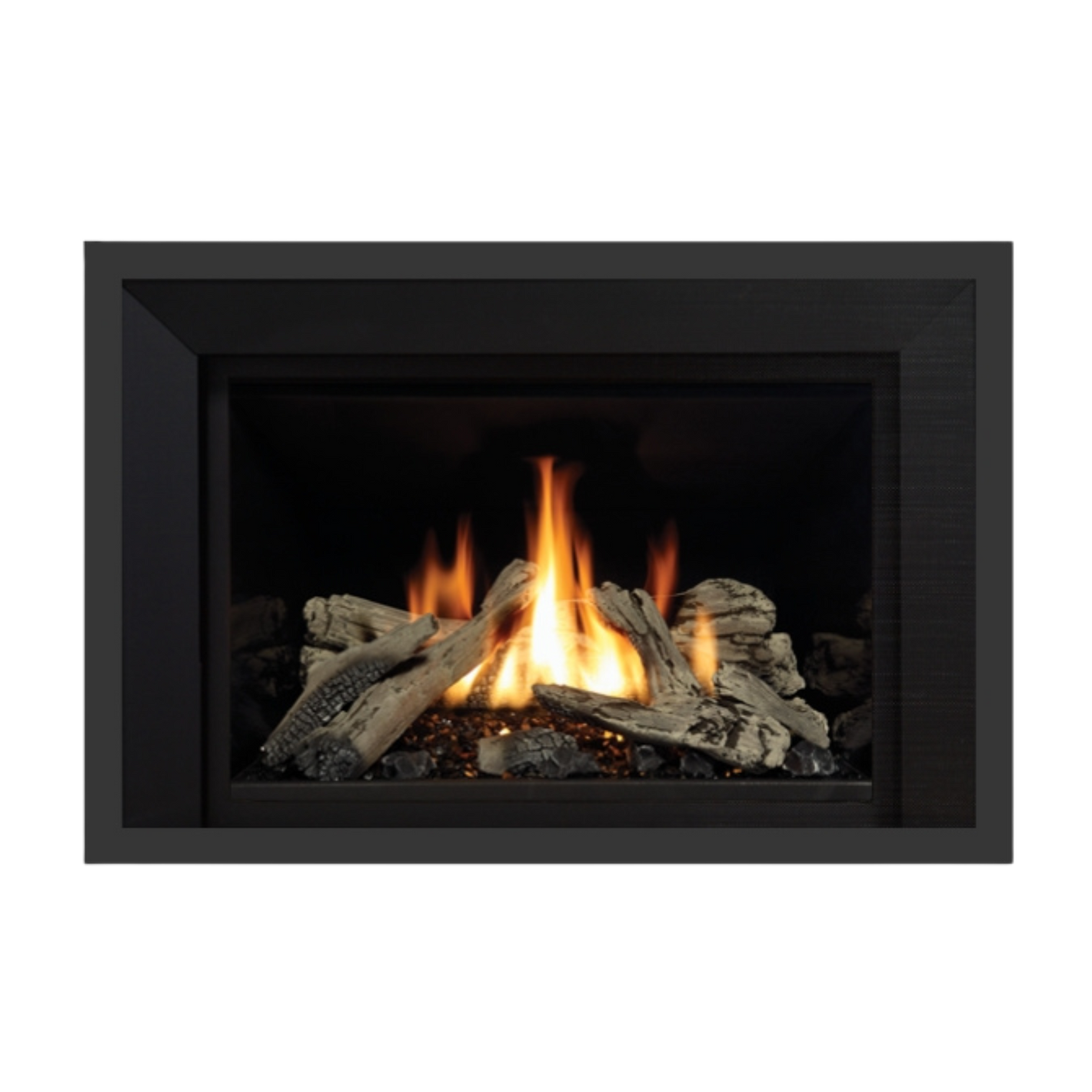

A direct-vent gas insert is a sealed gas heater that slides into the wood-burning fireplace you already have and vents through your existing chimney. This is Regency's Liberty Radiant family of them, in three sizes chosen by the width of your fireplace opening: the 28.5-inch LRi3E, the 30-inch LRi4E, and the 34-inch LRi6E. The Liberty is built around radiant heat — a High-Definition-Fire ceramic log set behind heat-radiating ceramic glass, backed on the 30 and the 34 by a six-tube heat exchanger and on every size by a variable-speed blower that pushes convective warmth into the room. Gas input runs from 20,500 BTU per hour on the 28.5 to 38,000 on the 34, every size turns down low for mild evenings, and delivered efficiency is among the strongest in Regency's insert lineup — EnerGuide ratings of 66 to 70 percent, steady-state up to roughly 73; each size's exact numbers are tabled under "How it actually performs." Every size includes electronic ignition with battery backup, the Proflame GTMF remote with thermostat control, ceramic glass, and a safety screen integrated into every faceplate. You make two design choices at order — the Vignette faceplate and the interior panel — and propane is a conversion kit your gas fitter installs. Configured pricing starts at $3,949.
Who this is for
The right buyer. You have an existing masonry or factory-built wood fireplace and want it converted to controllable gas heat with a traditional log fire — and you care about how much of the gas becomes warmth in the room. The Liberty's EnerGuide ratings of 66.25 to 70.37 percent are meaningfully higher than most decorative-first inserts, and its radiant character means strong, immediate warmth in front of the glass. The 28.5 fits openings smaller than most inserts can use; the 34 seals big older fireboxes. The Vignette faceplate system — seven styles from clean Black through Tudor and two Arched designs — covers traditional rooms most contemporary inserts cannot.
The wrong buyer. If you want app control from your phone, the Liberty has no WiFi option — Regency reserves that for the Atmosphere collection, compared at the end of this page. The same goes for ember-bed lighting and the in-log Infusion flame: the Liberty's fire is a classic log presentation, deliberately. If you heat a small room with propane and you're choosing the 30, note its propane turndown floor is 26,000 BTU per hour — it cannot idle gently on LP. And this is an insert: it needs an existing fireplace cavity, not a framed wall.
At a glance
Each size's heat numbers are tabled under "How it actually performs" below, and its space and clearance requirements under "Where it can go."
Where it can go
The Liberty installs into an existing wood-burning fireplace — masonry or listed factory-built — with two flexible aluminum liners run up the chimney: one for combustion air, one for exhaust, joined at a co-linear termination on top. Pick your size by the table below; the front width of your fireplace opening is the gate. On the 30 and the 34, an optional spacer kit lets the faceplate stand off a shallow firebox, trimming the depth requirement by about two and a quarter inches. Arched faceplates change the geometry slightly and exclude rectangular backing plates; backing plates in five sizes per model dress openings larger than the faceplate.
28.5-inch — LRi3E fit
30-inch — LRi4E fit
34-inch — LRi6E fit
Mantels
The figures above are for a combustible mantel one inch deep — the strictest case. Deeper mantels are permitted higher on a graduated chart in each manual: on the 30, for example, a mantel up to 12 inches deep may sit 24 inches above the top of the fireplace opening, which is 44 inches from the unit base. The 3-1/2-inch mantel deflector reduces every figure as tabled. Non-combustible mantels may sit lower when the framing behind them is metal stud and non-combustible board, but never closer than 6 inches above the fireplace opening.
Hearth and floor
Each size's non-combustible hearth requirement is in its table. On the 30 and the 34, raising the unit 6 inches off the floor — the adjustable hearth trim exists for exactly this — waives the hearth entirely. The 34's hearth must carry an insulation value of R-1.75; Regency's calcium-silicate board (296-936, supplied at no charge) plus three-eighths-inch tile meets it.
Code compliance
Installation must follow local codes; where none apply, the National Fuel Gas Code ANSI Z223.1 in the USA or CSA B149.1 in Canada governs. The units are approved by Warnock Hersey / Intertek as vented gas fireplace heaters, Category I. In Massachusetts, installation and repair must be performed by a licensed plumber or gasfitter. The label on your unit is the final authority wherever it differs from printed literature.
California Proposition 65
This product can expose you to chemicals including carbon monoxide, known to the State of California to cause birth defects or other reproductive harm. For more information go to www.P65Warnings.ca.gov.
What's in the box, what you'll add
Ships with the unit. The sealed firebox with burner and the High-Definition-Fire ceramic log set and ember bed, the variable-speed blower, the Proflame GTMF remote, heat-radiating ceramic glass, and the 30-degree flue collars. The 34 also ships with black steel interior panels installed — it is complete out of the box once a faceplate is on.
Chosen at order, included in the configured price. Your Vignette faceplate — Black, Tuscan Sunset, Platinum, Black Chrome, Tudor, Arched, or Arched Decorative, each with the safety screen built in — and your interior panels: a required choice of three brick designs or reflective black enamel on the 28.5 and the 30 (the 30 adds a black steel option), and an optional upgrade over the included steel on the 34. The Tudor faceplate on the 28.5 carries a two-to-four-week lead time from Regency.
You'll arrange. A licensed gas connection; the two-liner chimney run with a co-linear termination cap — the 30's spec sheet lists Regency's 946-529 co-linear termination, or DuraVent's 46DVA-GK adapter with a 46DVA-VC or 46DVA-VCH cap as the approved alternative; the LP conversion kit if you burn propane; and, optionally, a 120-volt hardwire connection so the blower runs without a visible cord.
Sold separately. LP conversion kits: 717-977 (28.5), 399-977 (30), 299-977 (34) — $98 each. Vignette inlays, Door or Craftsman in Black, for the Vignette Black faceplate only: 399-813 / 399-816 (30) and 299-813 / 299-816 (34), $261 each. Faceplate spacers: 399-818 $104 and arched 399-840 $131 (30); 299-818 $114 and arched 299-840 $147 (34). Backing plates — small / regular / 4-sided / oversized: 716-925 $147, 716-926 $196, 716-928 $229, 716-927 $203 (28.5); 399-825 $120, 399-826 $137, 399-828 $224, 399-827 $203 (30); 299-825 $175, 299-826 $203, 299-828 $240, 299-827 $240 (34); custom 3-sided and 4-sided: 716-931 $458 / 716-932 $520, 399-831 $538 / 399-832 $554, 299-831 $570 / 299-832 $610; arched: 717-847 $218 (28.5), 399-847 $251 (30). Adjustable hearth trim, 2 to 6 inches: 399-819 $213 (30), 299-819 $218 (34). Wall thermostats: basic 911-138 $64, programmable 910-404/P $250. Gas insert hardwire kit 946-854 $115. Rectangular backing plates cannot be used with arched faceplates.
How it actually performs
Gas input is the fuel the burner uses; what reaches the room depends on efficiency and on how the unit moves heat. The Liberty works both channels: the ceramic glass throws strong radiant heat into the space directly in front of the fire, and the blower pulls room air through the heat exchanger — six tubes on the 30 and the 34 — and returns it as circulating warmth. Two efficiency figures are published and they answer different questions. Steady-state is the unit running continuously at high fire — the Liberty's 71 to 75 percent is its headline. The EnerGuide rating (the regulated fireplace-efficiency protocol) models real start-stop use, and the Liberty's 66.25 to 70.37 percent is the number to compare across brands. Both are tabled below, both fuels, no selection.
One table per size. "Maximum input" is the most gas the burner can use in an hour — the size of the fire. "Turndown" is how low the flame can idle on a mild evening. Note the 30's propane floor before choosing fuel for a small room.
28.5-inch — LRi3E
30-inch — LRi4E
34-inch — LRi6E
Within Regency's own catalog the comparison is honest in both directions: the Atmosphere collection trades a few efficiency points for its in-log Infusion flame and lighting effects, while the Liberty banks the points. The Compare-with section at the end puts numbers side by side.
Trade-offs to know
No app control, no ember lighting. The Liberty has no WiFi kit and no ember-bed illumination — those are Atmosphere-collection features. Control is the Proflame remote or an optional wall thermostat. If evenings of glowing-ember theatre matter more than delivered efficiency, read the Atmosphere row in Compare-with before deciding.
Two remote generations across the line. The 28.5 ships with the Proflame II GTMF, the 30 and the 34 with the Proflame I GTMF. The feature set — smart thermostat, six flame levels, six fan speeds — is the same; the hardware generation is not, which matters if you ever mix units in one house.
The 30's propane floor is high. On LP the LRi4E turns down only to 26,000 BTU per hour — higher than the 28.5's maximum. In a small, tight room on propane it will cycle rather than idle. Natural gas turns down to 22,000. The price book prints 22,000 for LP as well; Regency's own spec sheet and brochure both say 26,000, and the official spec documents govern here.
Style costs are real. Black Chrome runs $1,141 to $1,213 against $480 to $602 for the Black faceplate; reflective enamel panels add $245 to $475 over bricks or steel; the 28.5's Tudor carries a two-to-four-week lead. None of it changes heat output by a single BTU.
Geometry constraints. Arched faceplates cannot pair with rectangular backing plates — only the arched backing plate fits — and inlays mount only on the plain Vignette Black faceplate. Configure the look as a set, not piece by piece.
Operating reality
Daily operation. In its default intermittent-pilot mode the unit lights on demand from the remote — no pilot burning gas between fires — with a five-second flame-failure response that re-establishes ignition quickly in cold, drafty chimneys. For deep-winter reliability a continuous-pilot mode is selectable; its pilot shuts itself off automatically after seven straight days without a call for heat. In a power outage the battery backup lights and runs the fire and the remote keeps working; the blower is a 120-volt device and waits for power, so you get radiant heat, not fan-driven circulation, until the lights come back.
Blower behavior. The fan runs off the unit's heat cycle — starting after the firebox warms, running on briefly after shutdown while the unit cools. That after-run is the design working, not a fault. Keep the louvers clear of dust and pet hair; a vacuum pass each season keeps it quiet.
Service. Book a professional service annually — burner and pilot inspection, glass gasket check, venting check — and keep the receipts; the warranty conditions documented maintenance. Clean the glass with a gas-fireplace-rated cleaner only, never ammonia products, and only when cool. Burner aeration adjustment is an installer-only task by design. In Massachusetts, all installation and repair work must be done by a licensed plumber or gasfitter.
First fires. Expect a curing odor and some film on the glass during the first hours of burning as paints and binders cure — run it hard with a window cracked, then clean the glass once cool. Register the warranty when the installer signs off.
Warranty and service
Fireplace Products International backs the Liberty with its limited lifetime gas warranty. In plain terms, by component:
Conditions that matter: the warranty applies to the original purchaser at the original installation site and does not transfer; registration and documented annual maintenance are required; coverage provides one replacement per component per term, with a fifty-percent refund as the fallback where replacement is not practical. Glass broken by impact, finish changes from use, and damage from unauthorized modification are excluded. Service runs through Kaminos and Regency's authorized dealer network.
Compare with
Three sizes, one discipline: pick the opening width, pick the faceplate, pick the panels — and the price you configure is the price, with the screen, the blower and the remote already in it.