


Osburn Horizon Wood Fireplace
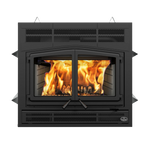
A 4.28 ft³ zero-clearance wood-burning fireplace with double cast-iron-framed glass doors, an included 176 CFM blower, 25-inch maximum east-west log capacity, and 29 3/4" × 13 1/2" ceramic glass. EPA 2020 cordwood certified at 64% HHV efficiency and 1.6 g/hr emissions, with up to 11-hour maximum burn and 95,000 BTU/hr peak output. Built into a new or properly rebuilt framed chase as primary or supplemental heat for moderately to well-insulated homes in the 1,300–2,200 sq ft real-world range. Ships as a required component bundle — the fireplace body, Prairie Style faceplate, and classic moulded brick panels together as the manufacturer's required configuration; no buyer-configurable choices at order. Choose the options below; the price updates as you go.
- Type: Wood fireplace, EPA 2020 certified
- Heats: 1,000–2,800 sq ft
- Heat output: 95,000 BTU/hr
- Log length: 16 in east-west
- Efficiency: 64% HHV / 69% LHV
- Burn time: Up to 11 hours
- Chimney: 8 in
- Made by: Osburn, by Stove Builder International, Quebec, Canada
Who it's for
Right buyer. Owners of moderately to well-insulated homes between roughly 1,300 and 2,200 sq ft who want a built-in wood-burning fireplace with the heat output and EPA 2020 cordwood compliance of a serious heating appliance, not a decorative-only fireplace. The 4.28 ft³ firebox is the largest in the Osburn wood fireplace lineup — primary-heat capability for larger spaces where the smaller Everest III's 3.04 ft³ firebox falls short.
New-construction buyers framing a fireplace chase from scratch per the install manual's dimensions, OR substantial-renovation buyers replacing an aging factory-built prefab fireplace where the existing chase framing and chimney can be verified or rebuilt to meet the Horizon's specific requirements. Replacement is not a drop-in: the old prefab unit must come out completely, the old chimney must be removed or replaced with an approved 8-inch UL 103 HT / ULC S629 system, and the existing chase framing must meet the published framing dimensions and clearances or be rebuilt to meet them. The unit cannot slide into an existing prefab firebox and cannot reuse an unapproved chimney or framing system.
The Horizon is a zero-clearance fireplace — it ships with listed insulation, shielding, and standoffs that allow installation inside a framed combustible chase when the manual's framing dimensions, clearances, air spaces, chimney system, and finish-material requirements are followed. Buyers who want a generous 25-inch maximum log capacity. Most firewood suppliers cut at 16-inch lengths, but the Horizon accepts substantially longer splits for buyers who cut their own wood or order custom lengths. Combined with the 17 7/8" firebox depth, north-south loading allows packed overnight cycles with maximum fuel mass — 11-hour burn time at low setting is genuinely achievable, not aspirational.
Buyers who want the optional NightFlame ceramic glass upgrade — semi-transparent black ROBAX® glass that conceals the firebox when the fire is out and reveals the flame when burning. Available on the Horizon and a few other SBI premium models. Buyers who want forced-air heat distribution to a remote room. The optional Forced Air Kit redirects heat through insulated 6-inch flex ducting to a wall or ceiling grille in another room. For multi-room or zone heating in larger homes, the kit transforms the Horizon from a single-room heater into a multi-zone appliance.
Wrong buyer. Not for buyers retrofitting an existing masonry fireplace — that is a wood insert's job, not a zero-clearance fireplace. Look at the Osburn Matrix 2700 or Osburn 3500 insert if you have a masonry opening and want to upgrade its heating performance. Not for buyers heating smaller spaces under 1,300 sq ft as primary heat. The 4.28 ft³ firebox at low burn rate still throws substantial BTU into the room — owners of small to mid-size homes often find the Horizon over-sized, with the room overheating before the burn cycle completes. For smaller spaces, step down to the Osburn Everest III (3.04 ft³ firebox, 85,000 BTU/hr). Not for mobile-home installation. The Horizon is not approved for mobile-home installation in either the US or Canada per the manufacturer listing. Mobile-home owners need a different appliance category. Not for buyers who want set-and-forget heating.
Wood fireplaces require active operation: lighting, monitoring flue temperature, closing the air at the right moment, deciding when to reload. The fireplace can leave usable coals by morning, but do not expect steady, high output through an entire night without a final reload. Not for buyers expecting 12+ hour overnight burns with full output. Non-catalytic appliances give you 8–10 hours of useful heat from a packed firebox of dense hardwood; for longer steady-output burns, a catalytic stove is the right tool. The 11-hour figure on this appliance is maximum burn time, not maximum useful heat time. Not for buyers sensitive to mechanical sound at higher blower settings. Multiple owner reviews note the included 176 CFM blower is audible at higher speeds. Sit near a running unit at a dealer before purchase if quiet operation is a priority.
Will it fit?
Dimensions from the specification sheet
| Measurement | Value |
|---|---|
| Overall height | 43‑3/8" |
| Overall width | 50‑3/4" |
| Overall depth | 31‑3/4" |
| Shipping weight | 550 to 560 shipping lb |
| Glass, W x H | 29‑3/4 x 13‑1/2 |
| Door opening | 33 W x 12‑3/4 H |
| Firebox, W x H x D | 25‑3/8 W x 17 H x 17‑7/8 D |
Dimensions
| Measurement | Value |
|---|---|
| Firebox volume | 4.28 ft³ |
| Glass | 29 3/4" x 13 1/2", ceramic, double door |
| Minimum chimney height | 15 ft |
| Door opening | 33" W x 12 3/4" H |
| Overall dimensions | 50 3/4" W x 31 3/4" D x 43 3/8" H |
| Shipping weight | 560 lb |
Where it can go
The Horizon is designed for installation in a permitted residential space — a living room, great room, family room, or any habitable room with adequate floor and wall framing to accept the zero-clearance chase and the 8-inch chimney system. Not approved for mobile or manufactured-home installation, drop-in replacement of an existing prefab/decorative fireplace (the unit cannot slide into an existing prefab firebox and cannot reuse the old chimney or framing if those do not meet the published requirements), or outdoor or unconditioned-space installation. Replacement installs are possible only when the old fireplace and chimney are fully removed and the chase is verified or rebuilt to meet the required framing dimensions, clearances, and the approved 8-inch UL 103 HT / ULC S629 chimney requirement.
This is a zero-clearance unit — it ships with listed insulation, shielding, and standoffs that allow installation inside a framed combustible chase when the manual's framing dimensions, clearances, air spaces, chimney system, and finish-material requirements are followed. No masonry shell is required, but no surface of the firebox or chimney connection is permitted to touch combustible material outside the manual's listed zones.
Clearances to combustibles
Floor protection
A hearth extension is required if the fireplace is installed directly on the floor or on a raised base of less than 4 inches. The hearth extension must be a continuous non-combustible material extending in front of the fireplace per the install manual's specifications. If the fireplace sits on a raised base of 4 inches or more, the hearth extension requirements may differ — refer to the install manual's hearth-extension section.
Clearances
The 24-inch combustible side-wall clearance is larger than the 21-inch on the Everest III and 13-inch on the Solution 2.5 ZC II — this fireplace needs more lateral wall framing space. Verify chase width with your installer before committing.
Clearances apply identically in Canada and the USA per the manufacturer's clearance table. The certification label on the unit is the binding clearance for any installation and always overrides clearance figures published in any other media. Some appliances have been tested with a low ceiling — refer to the installation manual for reduced-ceiling configurations. Confirm the binding clearance figures with your installer before purchase.
Heat and burn
From the specification sheet
| Spec | Value |
|---|---|
| Heating area | 1,000 to 2,800 sq ft |
| Maximum heat output | 95,000 BTU/h |
| Efficiency | 69% LHV average |
| Burn time | 10 to 11 h |
| Firebox volume | 4.28 cu ft, up to 60 lb of wood |
| Log length | 25 in |
| Emissions | 1.6 g/h |
| Blower | 176 CFM included |
| Spec | Value | What it means |
|---|---|---|
| Combustion technology | Non-catalytic | Secondary-air tubes reignite smoke gases. No catalyst to replace; simpler operation than a cat appliance but shorter low-and-slow burn times. |
| Maximum heat output | 95,000 BTU/hr | Peak output on dry cordwood, transient. Based on loading density of 15–20 lb/ft³ and reloading intervals of 60–120 minutes. Sustained output across a burn cycle is substantially lower. |
| Heating range | 1,000–2,800 sq ft | Manufacturer's stated range. Real-world comfort sizing for primary heat is roughly 1,300–2,200 sq ft in moderate climates and lower in cold climates or older homes — depends on insulation, layout, climate, ceiling height, fuel quality, and installation. |
| Average efficiency | 64% HHV / 69% LHV | 70% LHV optimum efficiency at low burn rate; 69% HHV optimum heat-transfer efficiency. HHV is the federal standard. |
| Particulate emissions | 1.6 g/hr | EPA 2020 cordwood certified (limit is 2.5 g/hr) — well below the ceiling. Tested by an independent accredited laboratory. |
| Average CO emissions | 159 g/hr | Average carbon monoxide emissions per CSA B415.1‑10 stack-loss method. Higher than the smaller Everest III at comparable output — a function of the larger firebox running at low burn rates where CO formation is higher. |
| Maximum burn time | Up to 11 hours | Manufacturer maximum from a packed load of dry hardwood with the air shut down hard. Useful heat through a burn cycle is realistically 8–10 hours. The 11-hour maximum is achievable but represents the tail end of the burn with minimal useful heat output. |
| Recommended log length | 16 in east-west | Per manufacturer spec. Most firewood suppliers cut to this length. |
| Maximum log length | 25 in east-west | Generous capacity for buyers cutting their own wood or ordering custom lengths. The 17 7/8" firebox depth also accepts north-south loading for packed overnight cycles. |
| Combustion chamber | 25 3/8" W x 17 7/8" D x 17" H | Inside firebox dimensions per manufacturer spec. The 17 7/8" depth accepts loading over both width (east-west) and depth (north-south) — useful for packed overnight cycles. Loading is over width per the manufacturer's loading specification. |
Choose your options
Options
The unit price is Osburn's 2026 list price for the wood fireplace alone. Options sold on this page add to it; those marked on request we add to your order by hand.
Faceplate and trim
| Faceplate and trim | Part | Price |
|---|---|---|
| PRAIRIE STYLE FACEPLATE | OA10631 | $825 |
| CLASSIC MOULDED BRICK PANELS | AC02360 | $650 |
Fresh air
| Fresh air | Part | Price |
|---|---|---|
| 5"Ø AIR INTAKE TERMINATION WITH CLAMPS (on request) | AC01297 | $66 |
| 5''Ø FRESH AIR INTAKE REGISTER WITH AIRTIGHT DAMPER (on request) | AC01349 | $285 |
| 5"Ø X 10' INSULATED FLEX PIPE FOR FRESH AIR INTAKE (on request) | AC02093 | $75 |
Other options
| Other options | Part | Price |
|---|---|---|
| 6"Ø X 25' INSULATED FLEX PIPE FOR FORCED AIR KIT (on request) | AC01350 | $225 |
| WARM AIR CIRCULATION GRILLE - MODERN (on request) | AC01378 | $385 |
| 5"Ø X 25' INSULATED FLEX PIPE (on request) | AC02094 | $165 |
| TEMPERED GLASS HEARTH PAD 10 mm - 18" X 50" (on request) | AC02760 | $399 |
| SEMI-TRANSPARENT BLACK GLASS WITH NIGHTFLAME EFFECT (SET OF 2) (on request) | AC02770 | $749 |
| FIREPLACE CARRYING HANDLES (on request) | AC09200 | $100 |
Chimney and installation
Chimney requirements from the specification sheet
| Requirement | Value |
|---|---|
| Flue | 8 in |
| Chimney type | CAN/ULC S629, UL 103 HT |
| Minimum chimney height | 15 ft |
| Mobile home installation | no |
| Flue center | 25‑3/8 in from the side |
An 8-inch chimney flue system is required. New factory-built chimney systems must comply with UL 103 HT (USA) or ULC S629 (Canada) and be suitable for solid fuel. Approved manufacturer/brand combinations listed by SBI include American Metal HSS and HS, DuraVent DuraTech / DuraTech Canada DTC / DuraTech Premium / Dura Plus HTC / Dura Plus, Metal Fab Temp Guard, Olympia Rockford and Champion, Ventis (Olympia/SBI Venting Division), Nexvent (SBI Venting Division), Security Chimney S-2100+, and Selkirk CF Sentinel / Super Pro 2100 / Super Vent 2100. Verify the chimney brand and component series with your installer before ordering venting.
The minimum chimney height is 15 feet, subject to installer verification, certification label, draft conditions, and local code. The chimney must extend at least 3 feet above the highest point of contact with the roof and at least 2 feet above any roof line or obstacle within 10 feet horizontally.
Outside air
Outside air is not required in conventional homes — combustion air is normally available from room air. However, a 5-inch fresh-air intake register with airtight damper and 5-inch insulated flex pipe are strongly recommended for tight new-construction homes with mechanical ventilation, for homes with powerful range hoods or other mechanical exhaust appliances, and where local code requires it. A smoke detector and carbon monoxide detector are required in the room where the fireplace is installed.
Codes and approvals
Code compliance for any specific installation is determined by the local Authority Having Jurisdiction. Manufacturer listings cover what the fireplace is approved for; the AHJ approves what is permitted at your address. A WETT (Canada), NFI, or CSIA (USA) certified installer is strongly recommended and frequently required by code, permit, or insurance. Zero-clearance wood-burning fireplaces are a regulated category — confirm local requirements before purchasing, particularly in EPA non-attainment counties and in HOA jurisdictions where new wood-burning installs may be restricted.
California Proposition 65
This product can expose you to chemicals including carbon monoxide, which is known to the State of California to cause cancer, birth defects or other reproductive harm. For more information go to www.P65warnings.ca.gov.
What arrives
- Horizon zero-clearance fireplace with welded steel firebox, double cast-iron-framed glass doors, classic moulded refractory brick panel interior, and stainless-steel secondary-air tube assembly
- Prairie Style faceplate
- Listed insulation, shielding, and standoffs that allow installation inside a framed combustible chase per the manual's required clearances, framing dimensions, air spaces, and finish-material zones
- 176 CFM blower with rheostat speed control
- C-Cast or equivalent baffle
- Owner's installation and operation manual and product documentation
Sold separately
- Code-compliant 8-inch Class A insulated chimney system — listed factory-built chimney from an approved manufacturer/brand per the manufacturer's approved-chimney list; required venting components are sold separately
- Hearth extension or floor protection sized to manual specifications, with continuous non-combustible material in front of the fireplace
- Optional Forced Air Kit (SBI VA4460) — distributes heat to a remote room via insulated ducting; pairs with 6" × 25' insulated flex pipe (SBI AC01350)
- Optional Warm Air Circulation Grille (SBI AC01378) — modern grille design for the remote-room terminus of the forced air kit
- Optional NightFlame Semi-Transparent Black Glass set of 2 (SBI AC02770) — ROBAX® ceramic glass upgrade that conceals the firebox interior when the fire is out and reveals the flames when burning
- Optional Tempered Glass Hearth Pad 18" × 50" (SBI AC02760) — coordinated hearth extension finish
- Optional 5" Fresh Air Intake Register with Airtight Damper (SBI AC01349), 5" × 10' Insulated Flex Pipe for fresh air intake (SBI AC02093), 5" × 25' Insulated Flex Pipe (SBI AC02094), and 5" Air Intake Termination with Clamps (SBI AC01297) — for tight homes or where local code requires outside air
- Optional Fireplace Carrying Handles (SBI AC09200) — site handling aid during installation; not part of the finished assembly
- Optional 48" Wood Storage with Finishing Trim (SBI AC02351) and Drawer and Tool Kit for Wood Storage Insert (SBI AC02353) — coordinated wood storage solution
- Digital moisture reader (SBI AC07835) and probe thermometer — strongly recommended; not optional in practice
- Glass cleaner (SBI AC07825), dry cleaning pad (SBI AC07824), gloves (SBI AC07820 or AC07822), fire starters — consumables for normal operation and maintenance
- Installation by an authorized qualified technician (WETT, NFI, or CSIA certified) and a framing contractor familiar with zero-clearance fireplace chase construction — required for warranty coverage and often required by code, permit, or insurance
Before you order
- Check with your building department and insurer: wood appliances need a permit in most places and an inspection after installation.
- The chimney is the other half of the system. It is sold separately and quoted from your installer's plan.
- Clearances and floor protection come from the manual and depend on the pipe and shields you choose. Send us your plan and we will check it.
- Burn seasoned wood below 20 percent moisture. Wet wood is the cause of most complaints about any wood stove.
- Special-order goods ship by freight.
How it performs
The 95,000 BTU/hr maximum is a peak rating, transient, achieved on dry cordwood at high loading density and short reload intervals. The figure that matters for daily life is the sustained output across a full burn cycle, which lands in the 16,900–43,000 BTU/hr band per the CSA B415.1-10 stack-loss method.
A realistic operating day, primary-heat use, cold climate: morning reload at sunrise produces a fast 60–90 minute warm-up and several hours of high output; mid-afternoon reload sustains heat through evening; a full pack at bedtime gives 8–10 hours of useful heat overnight, with the fireplace at coals by morning. In practical use with seasoned oak, maple, or hickory, expect 9–11 hours of useful heat from a packed load. With birch, pine, or softer wood, expect 6–7 hours.
The 4.28 ft³ firebox is the largest in the Osburn wood fireplace lineup. The 11-hour maximum burn time is genuinely achievable with the right wood — dense hardwood, properly seasoned, packed tight, air shut hard at the end of the load cycle. The smaller Everest III maxes at 8 hours from a 3.04 ft³ firebox; the Horizon's extra 1.24 ft³ of firebox volume translates directly to longer burn cycles and bigger fuel mass.
The 64% HHV average efficiency is in line with the larger SBI wood fireplaces — the Solution 4.5 ZC sister-brand model on the same chassis runs the same number. Optimum efficiency of 70% (LHV) at low burn rate is competitive within the EPA 2020 cordwood category. HHV is the federal standard.
The 25-inch maximum log capacity is generous for a 4.28 ft³ firebox and the largest of any Osburn wood fireplace. Most firewood suppliers cut to 16 inches, but buyers who cut their own wood or order custom lengths can take advantage of the wider firebox for longer splits. The 17 7/8" firebox depth also accepts loading over both width (east-west) and depth (north-south) — north-south loading allows packed overnight cycles with maximum fuel mass.
The included 176 CFM blower meaningfully improves heat distribution into the room and adjacent spaces. Air is distributed from behind the firebox out through the louvers. Multiple owner reviews note the blower is audible at higher speeds — comparable to a quiet bathroom exhaust fan at max. At low speeds the appliance is quieter, but the blower is part of the operating experience either way.
With the optional Forced Air Kit installed and properly sized, the manufacturer expects at least 25% heat transfer to a remote room — typically a bedroom on the same floor, or an adjacent zone of a great-room layout. The kit takes heat that would otherwise stay in the chase and routes it via 6-inch insulated flex pipe to a wall or ceiling grille in another room.
The 1.6 g/hr particulate emissions is well below the EPA 2020 cordwood limit of 2.5 g/hr — lower than the Everest III's 1.9 g/hr and matches the Solution 4.5 ZC. The 159 g/hr CO emissions is higher than the smaller Everest III — a function of the larger firebox running at low burn rates where CO formation is higher.
Trade-offs to know
Required component bundle, no buyer choices at order. The Horizon ships with the fireplace body, Prairie Style faceplate, and classic moulded brick panels as the manufacturer's required configuration — three SKUs ordered together as a package. No faceplate options, no door overlay choices, no brick panel alternatives. Customization is limited to where you place it, what hearth extension you specify, and which optional accessories you add (NightFlame glass, Forced Air Kit, hearth pad).
8-inch chimney requirement adds install cost. The Horizon's 8-inch chimney is larger than the 6-inch chimney used by the smaller Osburn Everest III and most freestanding wood stoves. 8-inch Class A chimney components run substantially more expensive than 6-inch components, and the larger flue requires more clearance and a larger chase footprint. Factor the chimney cost into the total project budget.
Larger combustible side-wall clearance. 24 inches of combustible side-wall clearance is more than the 21 inches required for the Everest III or 17 inches for many smaller models. The chase needs wider lateral framing space — verify the wall depth where the fireplace will be installed before committing.
Lower efficiency than freestanding stoves. A wood fireplace at 64% HHV average efficiency is realistically 5–10 efficiency points lower than freestanding wood stoves of comparable firebox volumes. The architectural integration of a built-in fireplace costs heat — less exposed appliance surface to radiate into the room, more heat lost into the chase. Choose a fireplace for the architectural look and the wall-integrated install; choose a freestanding stove if maximum efficiency per cord of wood is the priority.
Higher CO emissions than smaller siblings. 159 g/hr CO is higher than the Everest III (per manufacturer published unit) — a function of the larger firebox running at low burn rates. Lower CO is achievable with hotter, shorter burn cycles, but that trades against the long-burn capability that makes the larger firebox worth buying. The CO figure remains well within typical wood-burning ranges.
Forced air kit is sold separately. While the 176 CFM blower is included, the Forced Air Kit that redirects heat to a remote room is an additional line item. For multi-room or multi-zone heating, plan the kit cost and the chase pre-routing for the 6-inch flex pipe before framing.
Non-catalytic burn time. A non-cat appliance gives you simpler operation and no catalyst to replace, but you pay for it with shorter useful-heat windows. The 11-hour maximum claim is achievable on a packed load of dense hardwood with the air shut down hard; useful heat through that cycle is realistically 8–10 hours. For 12+ hour overnight burns with steady output, a catalytic or hybrid stove is the right tool.
Blower noise at higher speeds. Multiple owner reviews flag the blower as noisy at higher settings. The blower is essential for distributing heat from the back of the chase into the room, but at higher CFM settings the mechanical sound is audible. Find the right balance between heat distribution and acoustic comfort for your space.
Living with it
First burns. The first three to six fires release paint VOCs as the high-temperature stove paint cures. The smell can be strong during paint cure-in. Ventilate the room well, avoid prolonged exposure, and expect the odor to disappear after the first several hot burns.
Lighting. The manual describes top-down lighting as an effective method — largest splits on the bottom, smaller above, kindling on top, fire starter at the very top, light the top. Cleaner ignition, less smoke, faster to operating temperature.
Air control. Full open at light-off, then gradually closed only after the load is fully engaged and stable secondary flames are established. A flue thermometer is strongly recommended — without one, you are guessing at draft, burn rate, and overfire risk. The manual specifies keeping flue temperature in the comfort zone of 250–475 °F at steady state, with 700 °F acceptable transiently during start-up. Do not maintain excessive temperatures over long periods.
Reload cadence. 3–5 hours between reloads in active high-output use; 8–10 hours for a final overnight pack with the air shut hard. Open the air, wait 30 seconds, open the door slowly to avoid spilling smoke into the room. Place at least three pieces on the fire at a time so that the heat radiated from one piece helps ignite the pieces next to it. Loading is over width (east-west) per the manufacturer's loading specification. The 17 7/8" firebox depth also accepts north-south loading for packed overnight cycles.
Blower management. The blower starts automatically via the included heat sensor when the fireplace reaches operating temperature, typically about an hour after cold start. Turn the rheostat to LO or HI to set speed; the sensor handles on/off. Turn the blower OFF before opening the door fully — otherwise it can blow ash out of the firebox into the room. Find the right blower speed for your acoustic comfort — multiple owners run the blower at lower speeds to reduce mechanical sound at the cost of some heat distribution.
Glass cleaning. Damp newspaper dipped in cold ash, or a dedicated ceramic-glass cleaner. Daily wipe during low-burn weather; weekly during high-burn. Black streaks at the lower edge mean wet wood; black uniformly across the glass means burns are running too cool. Do not clean the glass when the fireplace is hot, and do not strike or slam the glass doors shut.
Door alignment and gasket replacement. The door gasket needs replacement when the paper-strip test fails: close the door on a strip of paper and try to pull it out; firm resistance means the gasket is sealing, easy pull means it's time to replace. The double-door design has gaskets on both doors and at the meeting edge — test all locations. Plan on gasket replacement every 3–5 seasons in regular use. Replacement gasket kits are available through the SBI parts network.
Annual chimney sweep. Per the manual, the chimney should be cleaned and inspected at least once each year. Inspect monthly during the heating season until you know your creosote-formation rate; if buildup reaches 1/8 inch, sweep immediately. Heavy burners or those with marginally seasoned wood may need mid-season cleaning. The 8-inch chimney brushes and rods are larger and more expensive than 6-inch equivalents — factor into operating costs.
Specifications
| Appliance type | Zero-clearance wood fireplace |
|---|---|
| Combustion technology | Non-catalytic |
| Firebox volume | 4.28 ft³ |
| Maximum heat output | 95,000 BTU/hr |
| Tested output range | 16,900–43,000 BTU/hr |
| Heating range | 1,000–2,800 sq ft |
| Average efficiency | 64% HHV / 69% LHV |
| Particulate emissions | 1.6 g/hr |
| Average CO emissions | 159 g/hr |
| Maximum burn time | Up to 11 hours |
| Recommended log length | 16 in east-west |
| Maximum log length | 25 in east-west |
| Construction | Steel firebox, double cast-iron-framed glass doors |
| Faceplate | Prairie Style, included |
| Brick panels | Classic moulded, included |
| Baffle | C-Cast or equivalent |
| Glass | 29 3/4" x 13 1/2", ceramic, double door |
| Blower | 176 CFM, included |
| Flue connection | 8 in |
| Minimum chimney height | 15 ft |
| Combustion chamber | 25 3/8" W x 17 7/8" D x 17" H |
| Door opening | 33" W x 12 3/4" H |
| Overall dimensions | 50 3/4" W x 31 3/4" D x 43 3/8" H |
| Shipping weight | 560 lb |
| Mobile home approved | No |
| Standards | UL 127 / ULC-S610, EPA / ASTM WK47329 / CSA B415.1‑10 |
| Country of origin | Made in Canada |
| Model | OB04010 |
| Manufacturer | Osburn, by Stove Builder International (SBI), Quebec, Canada |
| Certification | UL 127, ULC S610; EPA 2020 |
| Warranty | Limited lifetime |
| Specification source | SBI specification table as published by Osburn dealers (blazingembers.com, buildwithrise.com), 2026 |
Warranty
A one-time replacement limit applies to all parts with lifetime coverage. Warranty is void if the unit is used to burn anything other than seasoned cordwood, or if it is not operated according to the owner's manual. Damage caused by misuse, improper installation, lack of maintenance, overfiring, downdrafts, venting problems, or under-estimated heating area is not covered. Improper installation by anyone other than an authorized qualified technician voids the warranty.
Warranty claims are made through your Osburn dealer and remain subject to SBI/Osburn inspection, approval, and the current written warranty. Kaminos is the retailer for this fireplace and supports buyers through purchase; final warranty approval rests with SBI as the manufacturer. SBI's parts network is well-stocked — replacement bricks, baffle, secondary tubes, glass, gaskets, blower, faceplate, and venting components are openly available at fair prices through multiple parts vendors.
Osburn may require photos or returned parts to support a claim; repair work covered by warranty requires prior manufacturer approval.
Coverage details can change by component and warranty revision; the current Osburn warranty controls.
Questions people ask
How does it compare with the other Osburn models?
- Osburn Everest III Smaller sibling in the Osburn wood fireplace line — 3.04 ft³ overall firebox volume, 2.61 ft³ EPA loading volume, 85,000 BTU/hr maximum output, 25,900–78,200 BTU/hr tested band, 750–2,500 sq ft heating range, 65% HHV / 71.6% optimum efficiency, 1.9 g/hr particulate emissions (higher than Horizon's 1.6), 8-hour max burn, 20-inch log capacity, 6-inch chimney, 525 lb shipping weight, 18 3/4" × 11" glass (smaller than Horizon's 29 3/4" × 13 1/2"). Two buyer-configurable choices at order (faceplate Traditional/Modern and door overlay Black/Brushed Nickel) vs Horizon's required component bundle. Retractable cast-iron door architecture; mobile-home approved in Canada (Horizon not mobile-home approved). Choose the Everest III for smaller homes, retractable-door architecture, two configurable design choices at order, 6-inch chimney's lower install cost, and Canada mobile-home compatibility; choose the Horizon for the larger 4.28 ft³ firebox, 25-inch logs, longer 11-hour burn, primary heat across larger spaces up to 2,800 sq ft, the wider horizontal glass viewing area, and lower particulate emissions. Enerzone Solution 4.5 Sister-brand counterpart from SBI's Enerzone line — same chassis as the Horizon, same 4.28 ft³ firebox, same 95,000 BTU/hr maximum output, same 16,900–43,000 BTU/hr tested band, same 64% HHV / 70% optimum efficiency, same 1.6 g/hr particulate emissions, same 159 g/hr CO, same 11-hour max burn, same 25-inch log capacity, same 8-inch chimney, same 176 CFM included blower, same 560 lb shipping weight, same 29 3/4" × 13 1/2" glass, same not-mobile-home-approved. Buyer-configurable louver choice at order (Traditional default or Rustic upgrade). Different brand finish and faceplate styling. Choose the Solution 4.5 ZC for the louver configuration choice and the Enerzone brand finish; choose the Horizon for the Prairie Style faceplate styling and the Osburn brand and dealer network. Valcourt FP15A Waterloo Sister-brand counterpart from SBI's Valcourt line — same chassis class as the Horizon, 4.3 ft³ firebox, 1,000–2,800 sq ft heating range, 1.6 g/hr particulate emissions, 11-hour max burn, 8-inch chimney, included blower, EPA 2020 approved. Four buyer-configurable faceplate louver choices at order — substantially more configuration flexibility than the Horizon's single Prairie Style faceplate. Arched faceplate aesthetic vs the Horizon's clean horizontal lines. Valcourt is SBI's premium-positioned brand with Quebec-heritage design language. Choose the FP15A Waterloo for the four faceplate louver options, the arched aesthetic, and Valcourt's premium brand positioning; choose the Horizon for the Prairie Style faceplate's contemporary horizontal lines, Osburn's broader US dealer network, and typically lower purchase price.
- Enerzone Solution 2.5 II Smaller Enerzone wood fireplace — 2.5 ft³ overall firebox volume, 1.94 ft³ EPA loading volume, 80,000 BTU/hr maximum output, 12,700–60,700 BTU/hr tested band, 750–2,200 sq ft heating range, 64% HHV / 68% LHV efficiency, 1.2 g/hr particulate emissions (lower than Horizon's 1.6), 98 g/hr CO (lower than Horizon's 159), 8-hour max burn, 20-inch log capacity, 6-inch chimney, 523 lb shipping weight, 22 1/4" × 13 1/2" glass (smaller than Horizon's 29 3/4" × 13 1/2"). Included cast-iron andirons, sealed double-door design. Choose the Solution 2.5 ZC II for smaller homes, lower emissions, lower CO, smaller chase footprint, 6-inch chimney's lower install cost, and the Enerzone brand finish; choose the Horizon for the larger 4.28 ft³ firebox, 25-inch logs, longer 11-hour burn, primary heat across larger spaces up to 2,800 sq ft, the wider horizontal glass viewing area, and the Osburn brand.
- Pacific Energy FP30 LE Premium cross-brand competitor in the EPA-certified large zero-clearance wood fireplace category, built by Pacific Energy in British Columbia. 3.0 ft³ firebox (smaller than 4.28), 74% optimum efficiency, 1.79 g/hr emissions, 22-inch maximum log capacity, two included 80 CFM temperature-actuated blowers, cast-iron door, EPA 2020 certified with Pacific Energy's Extended Burn Technology (EBT) and heavy-gauge floating firebox build. No retractable-door architecture; standard sealed-door design. Significantly higher purchase price than the Horizon. Choose the Pacific Energy FP30 LE for higher optimum efficiency, the Pacific Energy floating-firebox build philosophy, and the established premium cross-brand reputation; choose the Horizon for the larger 4.28 ft³ firebox, 25-inch log capacity vs 22-inch, wider horizontal glass viewing area, included 176 CFM blower, and lower purchase price.
What chimney does it take?
A 6-inch flue: a listed factory-built chimney rated UL 103 HT in the US or ULC S629 in Canada, or a lined masonry chimney in good repair. The connector pipe and chimney are quoted from your installer's plan.
Does it need a blower?
No. Every Osburn heats by radiation and natural convection. The optional blower moves warm air into the room faster and helps in a larger or open space; it needs a 120-volt outlet.
Can I install it myself?
Many owners do the placement and the pipe with the manual in hand, but the chimney, the permit and the inspection are where an installer earns the fee. Insurance usually requires the inspection.
Can I return it?
Stoves ship by freight. Confirm the model and the options with us before you order, and contact us before returning anything.
What wood should I burn?
Seasoned hardwood, split and dried a year or more, below 20 percent moisture. Wet wood smokes, coats the chimney with creosote and makes a poor fire.
How often does the chimney need sweeping?
Once a year at least, and after every cord or two if you burn nightly.
Can it go in a mobile home or an alcove?
The specification table on this page says whether the model is approved for a mobile home, with the fresh-air kit, and for an alcove, with the alcove clearances in the manual.
If you have any questions about this product, please let us know by filling out the form below, and we will contact you as soon as possible.
- Choosing a selection results in a full page refresh.